Researchers are exploring a new authentication system called AccLock, which uses AirPods-style earbuds to verify users through unique in-ear heart-rate signals. These signals are captured by built-in accelerometers. While early tests show promise, the technology is currently less reliable than Face ID, with accuracy being a key challenge.
From Touch ID to Face ID—and Now Ear ID?
After Touch ID and Face ID, the next big thing in biometric security might be Ear ID. Apple first introduced Touch ID with the iPhone 5S as a reliable security feature. However, it was discontinued in 2025 with the end of the iPhone SE (3rd generation). Since then, Face ID, launched with the iPhone X in 2017, has become the standard for facial authentication. But this could change with AccLock, which uses earbuds to authenticate users based on their unique heart rhythms.
How Does Heartbeat Authentication Work?
Heartbeat authentication leverages the fact that every person’s heart produces unique electrical impulses and cardiac patterns. These rhythms can serve as a biometric identifier, according to research published on ScienceDirect.
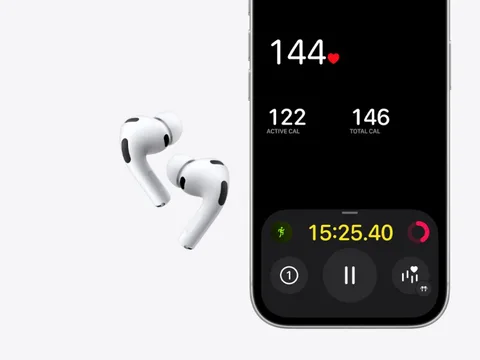
A team of researchers in China is developing AccLock, an earbud-based system that uses tiny accelerometers—already present in most earbuds, like AirPods—to capture these unique heart rhythms. In their preprint paper on Cornell University’s arXiv, the researchers describe AccLock as a potential breakthrough:
“In this paper, we propose a passive authentication system called AccLock, which leverages distinctive features extracted from in-ear BCG signals to enable secure and unobtrusive user verification. Our system offers several advantages over previous systems, including zero involvement for both the device and the user, ubiquity, and resilience to environmental noise.”
How Does AccLock Compare to Face ID?
Initial tests show that AccLock is promising but not yet as accurate as Face ID. The researchers conducted experiments with 33 participants, achieving a False Acceptance Rate (FAR) of 3.13% and a False Rejection Rate (FRR) of 2.99%.
In simpler terms:
- FAR (3.13%): About 3 out of 100 unauthorized users were incorrectly granted access.
- FRR (2.99%): About 3 out of 100 authorized users were denied access.
While these results demonstrate feasibility, the small sample size limits broader conclusions. As the technology matures, AccLock could become a viable alternative for biometric verification.
For comparison, Apple claims that Face ID has a FAR of 1 in 1,000,000, making it significantly more secure. However, Apple’s claims lack peer-reviewed research to back them up.
Testing and Challenges
The researchers tested AccLock on both 3D-printed earbuds and actual Apple AirPods. The prototype performed better with higher sampling rates and was more accurate when users listened to music, moved their heads, or adjusted their posture. However, performance dipped slightly on AirPods due to lower data quality. After some retraining, the system adapted to each user’s unique patterns during periods of stillness.
That said, certain movements—like walking, jogging, or even chewing—introduced vibrations that reduced accuracy. For now, AccLock remains a proof-of-concept and is not yet available in commercial products.
The Future of Biometric Security
As biometric verification methods like AccLock evolve, privacy concerns could grow. While the technology shows potential, it’s still in its early stages. With further development and testing, AccLock could one day join the ranks of Touch ID and Face ID as a mainstream security feature.