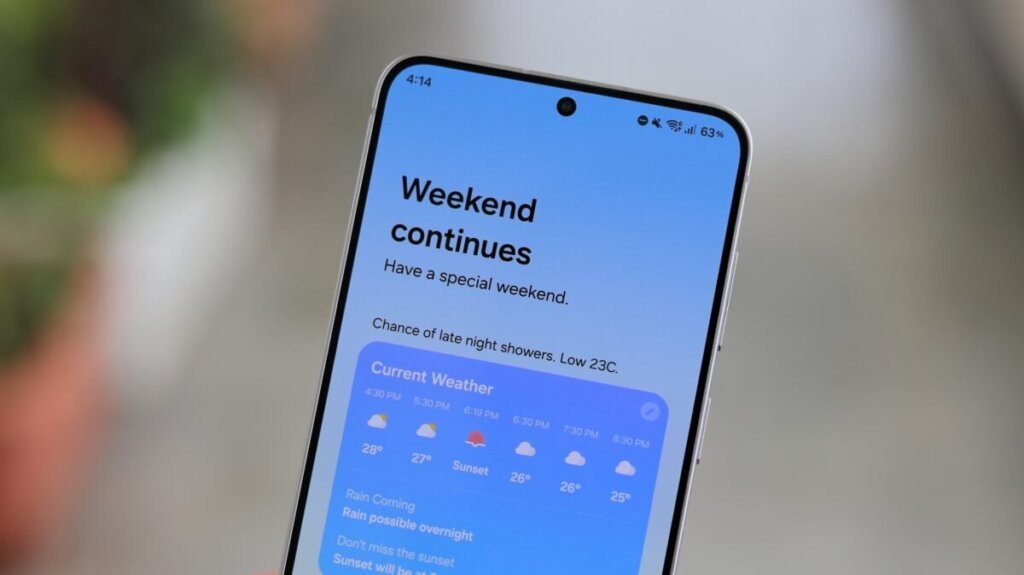
Galaxy AI has always asked you to make a trade: the cleverest features send your photos, notes and voice to Samsung’s servers, and all you get in return is a promise that your data won’t be stored. Now code buried in the One UI 9.5 beta suggests Samsung is building a way out of that trade — a private cloud, codenamed SPAC, that would process your AI requests on its servers without Samsung being able to tell who sent them. And in a first hands-on test this morning, it already works.
Samsung SPAC — the key facts
- What it is: a new Samsung framework, codenamed “SPAC”, for processing Galaxy AI requests in a private cloud
- Where it was found: code in One UI 9.5 Beta 1 on a Galaxy S26 Ultra, reported by Android Authority on November 26, 2026
- How it protects you: requests pass through a third-party relay, servers must prove they run genuine software, and your identity is hidden behind anonymous one-time passes
- Already tested: Android Authority got SPAC working with AI Select on November 27 — it pulled a calendar event from a screenshot more accurately than the standard version
- Status: switched off for now, no announcement from Samsung, no launch date — and nobody outside Samsung knows what SPAC stands for
How SPAC was found
Android Authority spent a week digging through One UI 9.5 Beta 1 on a Galaxy S26 Ultra and found a new Samsung software kit, called SPAC, sitting inside four system apps: Photo Editor, IntelliVoiceService (Samsung’s speech and language service), Smart Capture, and PhotoRemasterService. None of those apps had it in One UI 9. The code connects to a server-side gateway Samsung calls “Arcane”, alongside separate token, identity and fraud-detection services.
What SPAC actually stands for is unknown. Android Authority guesses it could mean “Samsung Private AI Cloud”, but is open about that being a guess — it could just as easily be something else. Samsung has not announced the system, has not commented on it, and Android Authority says it has asked the company for more details.
The timing is worth noting. Samsung opened the One UI 9.5 beta on November 18, 2026, for Galaxy S26 series owners in the US, UK, Germany, India, Korea and Poland. That beta is where all of this was found — and it is also where SPAC is, for now, switched off.
Four layers of privacy
Most of SPAC’s code, according to the teardown, deals with privacy and trust rather than AI itself. It appears to work in layers:
| Layer | What it does, in plain terms |
|---|---|
| A third-party relay | Your request passes through a middleman first, so Samsung can see what you asked but not where it came from. |
| Server attestation | Your phone checks that Samsung’s server is running genuine, untampered software before it sends anything. |
| A public record | Samsung’s server software is logged in a record that can’t be quietly changed, so it can’t swap in different software for some users. |
| Anonymous passes | Your phone gets one-time passes that prove you’re a real Galaxy user without revealing which user you are. |
There is one wrinkle: the code also includes an “unattested” mode, in which the phone skips some of these checks. Android Authority notes this could be for internal testing only. It is also not yet clear how SPAC will work with the existing “Process data only on device” toggle in Galaxy AI Settings — Photo Editor’s code checks that toggle, but the SPAC code in the other apps does not appear to, though Samsung could be handling it elsewhere in One UI.
It’s already working — the AI Select test
The most surprising part of the story arrived in an update on Friday morning, November 27: Android Authority managed to get SPAC working with AI Select, the Galaxy AI tool that reads what’s on your screen and suggests actions like adding a calendar event.
The test, reported in detail by SammyGuru, went like this. The team selected a Google search result showing upcoming Lollapalooza dates and tapped “Add event”. With the standard AI Select, the result was wrong: the event title came out as “Course Reservation” and the location field listed more than one venue. With SPAC switched on, the same selection took a different route — the request went to Samsung’s SPAC servers, took a few noticeable seconds longer, and came back as a clean “Add event” sheet: “Lollapalooza India”, January 23, 2027, at Mahalaxmi Race Course, Mumbai. Correct title, date and venue, with no edits needed.
It wasn’t perfect. The page listed five Lollapalooza editions, and SPAC returned only the first — possibly because the test phone was in Mumbai, or simply because it was the first entry in the list. Samsung’s code supports adding several events at once, so that may improve before the feature reaches users. The test used Alibaba’s Qwen 3.6 model, one of two AI models the code lists for AI Select, alongside Google’s Gemma 4.
Small as the demo is, it matters: it is the first sign that Samsung’s private AI cloud is real and not just code in a beta. A Galaxy phone can already send it a request and get a useful answer back.
What could run through SPAC
Based on the code, a large part of Galaxy AI’s cloud features could eventually move to SPAC instead of Samsung’s current servers:
| Galaxy AI feature | What SPAC would change |
|---|---|
| AI Select | Smarter at understanding your screen — pulling several events from a screenshot into your calendar at once. |
| Photo Editor | Cloud AI eraser and cloud photo upscaling, including zoomed camera shots, move to the private cloud. |
| Live speech translation | Translation through a route Samsung’s own code labels “private”. |
| Writing tools | Summarising, tone changes, emoji suggestions and writing help. |
| Now Brief | Your daily briefing, generated privately in the cloud. |
| Bixby work | An unnamed “GUI agent” and something called “Bixby work” are also mapped to SPAC in the code. |
For now, though, SPAC is gated behind newer Galaxy AI versions than the test phone reports, PhotoRemasterService needs a newer Remaster version, and there is no user-facing text about SPAC anywhere in the beta — no consent screen, no privacy notice. When Android Authority tested Writing Assist, AI Select, Note Assist, Now Brief and Interpreter while logging the phone’s activity, none of them touched SPAC. Everything either ran on the device or used Samsung’s existing cloud.
The AI models in the code
The teardown also names the AI models Samsung could run on its own servers. Smart Capture, which powers AI Select, lists Alibaba’s Qwen 3.6 and Google’s Gemma 4. IntelliVoiceService references Gemma 4. PhotoRemasterService references Black Forest Labs’ FLUX.2 klein 4B and a Stable Diffusion model. Photo Editor mentions OpenAI’s text-to-speech models, Samsung’s own Gauss model and Meta’s V-JEPA — though those don’t appear to be in use.
Samsung is following Apple, Google and Meta
SPAC is not a new idea — it is Samsung adopting a blueprint the rest of the industry has already drawn. Apple launched Private Cloud Compute with Apple Intelligence in iOS 18, back in 2024: requests carry no identifying information, go through a third-party relay that hides your IP address, and only go to servers that match a public, tamper-proof record. Google’s Private AI Compute, which launched in November 2025, works the same way, and Meta’s Private Processing does it for WhatsApp’s AI features.
| Company | Private cloud system | Status |
|---|---|---|
| Apple | Private Cloud Compute | Live since iOS 18 (2024), publicly announced and explained |
| Private AI Compute | Launched November 2025 | |
| Meta | Private Processing | Live for WhatsApp AI features |
| Samsung | SPAC | Found in beta code; not announced, not switched on |
As Android Authority puts it, Samsung is late to the party — and unlike Apple, Google and Meta, which all announced their systems publicly and explained how they work, Samsung hasn’t said a word yet about a private cloud for its users. SPAC might just be it.
Why this matters — and the paywall question
If SPAC works the way the early code suggests, Samsung could swap today’s “not stored by Samsung” policy promise for something it can actually prove: more powerful Galaxy AI features running in the cloud while your requests stay about as private as on-device processing. That would put Galaxy AI on equal footing with Apple Intelligence and Gemini on privacy — a real selling point for a company whose phones already lean heavily on AI.
It could matter even more because of money. We reported in our Galaxy AI Premium plan story that Samsung is testing a $4.99-a-month subscription for its most advanced AI tools. If the best Galaxy AI features end up behind a paywall and running on Samsung’s servers, a provably private cloud becomes the difference between paying for a service you trust and paying to hand your data over. A private cloud doesn’t make a subscription popular — but it does make it defensible.
There is also a practical side. The backend appears to be further along than the phone software: public certificate records show production server addresses for SPAC that Samsung has kept renewing over the past few months, and newer entries suggest it is adding servers in the US as well. The servers may already be in place, waiting for the features to switch on.
What people are saying
There are no owner reactions to report yet — SPAC isn’t switched on for users, so nobody outside the teardown has used it. The reaction so far is from the press, and it is cautiously positive. Android Authority’s verdict is that Samsung is following the industry’s standard recipe rather than inventing anything new, but that the recipe itself is a good one. Gadgets360 frames it as Samsung finally answering the privacy question Galaxy AI has carried since launch. SammyGuru, reporting the hands-on test, calls the AI Select improvement a noticeable one — the kind of small, everyday fix that makes the system feel smarter, not just more private.
What happens next
Nobody knows when SPAC goes live — Samsung hasn’t commented, and the beta has no timeline for it. The clues point to early 2027: SammyGuru expects the feature to arrive alongside the Galaxy S27 series, and our One UI 9.5 leaks report noted the stable update is expected with the S27 launch in early 2027. The Galaxy S27 Pro has already surfaced on Geekbench with its new Exynos 2700 chip, so the launch window is firming up — but Samsung has confirmed nothing about SPAC, One UI 9.5’s final date, or the S27 itself.
What to watch for: a Samsung announcement (the company has said nothing so far), a consent screen or privacy notice appearing in a future One UI 9.5 beta, and SPAC actually switching on for beta users. If the servers are already being provisioned, the gap between “code in a beta” and “feature on your phone” may be shorter than it looks.
Frequently asked questions
What is Samsung SPAC?
SPAC is the codename for a private cloud framework Samsung appears to be building for Galaxy AI, found in the code of One UI 9.5 Beta 1. It would let Galaxy phones send heavy AI tasks to Samsung’s servers while keeping the requests private — Samsung would see what you asked, but not who asked. Samsung hasn’t said what SPAC stands for; “Samsung Private AI Cloud” is Android Authority’s guess.
Is my Galaxy AI data private today?
Only partly. Features that run on your phone keep your data there. The more capable ones — Writing Assist, Note Assist, generative photo edits — send data to Samsung’s servers, where the promise is only a policy one: Photo Editor tells you your image “will be sent to servers for processing… but not stored by Samsung.” Your only alternative today is the “Process data only on device” toggle in Galaxy AI Settings, which switches the cloud features off entirely.
Will SPAC cost extra?
Unknown. Samsung hasn’t announced SPAC or any pricing for it. Separately, Samsung is testing a Galaxy AI Premium plan at $4.99 a month — see our report on the Galaxy AI Premium test — but there is no evidence SPAC itself will be paywalled.
Which phones will get it?
Unknown, and Samsung has confirmed nothing. The code was found on a Galaxy S26 Ultra running One UI 9.5 Beta 1, and reports expect the feature to arrive with One UI 9.5 — which is tipped to launch with the Galaxy S27 series in early 2027. Whether older Galaxy phones get it is an open question.
Watch: Samsung Is About to Charge for Galaxy AI — Tech Mansion on YouTube.