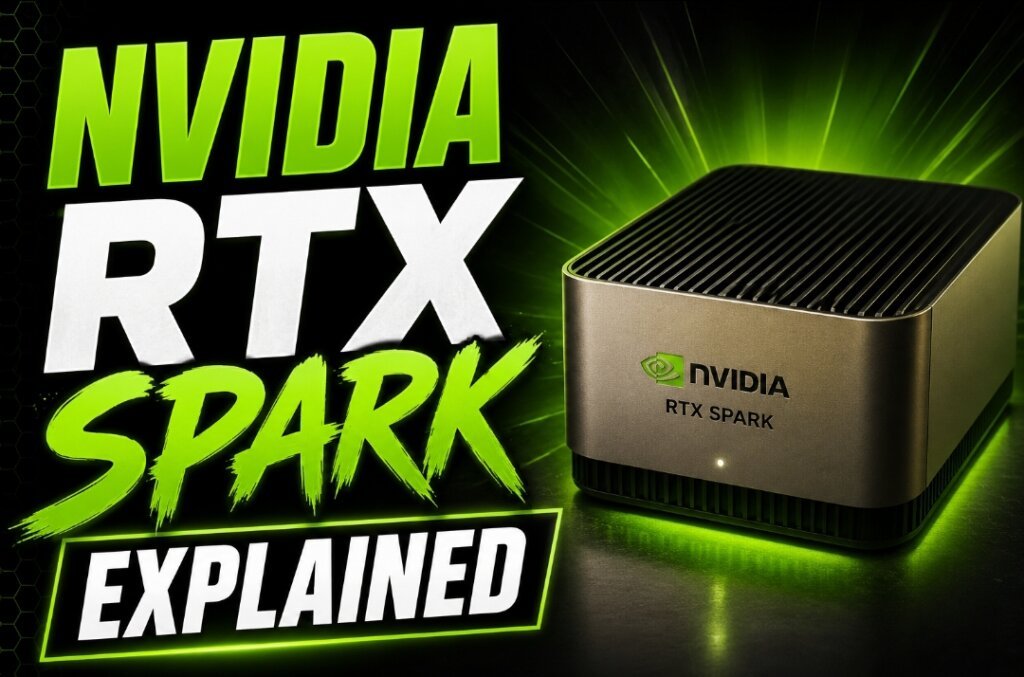
For years, the laptop market has been dominated by Intel and AMD processors and NVIDIA with its dedicated graphics solutions. In 2026, NVIDIA’s biggest leap yet came with the launch of the Nvidia RTX Spark, a new processor platform that powers next-gen Windows laptops and compact desktops. The announcement represents NVIDIA’s first significant move into the whole PC processor market, and may redefine the design of future notebooks.
RTX Spark is a platform that unifies computing, graphics, AI acceleration and memory. This method can lead to more efficient, faster AI performance, longer battery life, and even desktop-class performance in thin and light laptops, NVIDIA says.
The value of RTX Spark is more than just about performance. It’s a move towards laptops that are designed for AI, content creation and high performance computing, not just traditional applications.
So, what on earth is Nvidia RTX Spark?
The Nvidia RTX Spark is a system-on-a-chip (SoC) chip based on the Arm architecture for Windows PCs. The platform is not composed of individual processors for calculation and graphics, but it consists of several parts in one.
The flagship version comes with:
- A 20-core NVIDIA Grace CPU
- Up to 6,144 CUDA cores from a Blackwell based RTX GPU.
- Peter VanAulen explains the concept of 5th generation Tensor Cores, which will facilitate AI workloads.
- A unified LPDDR5X memory of up to 128GB.
- The performance of up to 1 petaflop of AI computing power
This architecture contrasts greatly with those of traditional laptops. Traditionally, CPUs, GPUs, and memory are standalone devices that communicate via several interfaces. With a single memory design, the CPU, GPU, and AI engines share the same pool of memory resources without growing any memory silos.
This ultimately leads to faster data transfer, reduced latency, and increased power efficiency.
Why RTX Spark Is Different From Current Laptop Chips
The most radical change is ‘integration’.
There are generally 4 types of processors used in modern laptops: the Intel processor, AMD processor, Apple Silicon processor and Qualcomm processor. NVIDIA’s offering on this market is a design that integrates technologies from its AI, graphics and data-center businesses on a single platform.
The RTX Spark architecture comes from some of the technologies employed in NVIDIA’s artificial intelligence systems and supercomputers. This enables it to support workloads which are typically challenging for thin laptops.
NVIDIA says that the chip can:
- Edit 12K video
- Create large 3D scenes.Generate huge 3D scenes.
- Develop complex AI model locally
- Provide the ultimate in RTX gaming experience
- Power complex creative processes across the battery.
This is what makes RTX Spark so special when it comes to a thin laptop.
NVIDIA’s focus is not just on gamers, but on AI, creative users, developers, and power users.
The AI Advantage
AI has been the main driver behind the creation of RTX Spark.
Cloud servers are heavily used in most of the present-day AI features. When engaging in tasks like image generation, language processing, and AI-assisted workflows, data is frequently passed to remote systems from time to time.
RTX Spark has been created to integrate numerous of these capabilities right onto the laptop. The platform is geared toward “agentic AI,” defined as AI systems that can continuously power users for tasks, automation, and content creation locally, NVIDIA says.
It has dedicated AI hardware and a massive amount of memory, enabling it to process much larger AI models than other laptops currently available. As for AI workloads, NVIDIA says it supports models with hundreds of billions of parameters.
This might enable future laptops to:
- Enjoy advanced AI assistants without needing an internet connection.
- Generate content locally
- Process large datasets
- Reduce the reliance on cloud services and increase privacy.
- Speed up software development and creative jobs
AI could be the main selling point for the RTX Spark-powered laptop models for a lot of consumers.
Gaming and Creative Performance
While the primary focus is on AI, gaming continues to be a key component of the platform.
RTX GPU, based in Blackwell, has the same architecture as NVIDIA’s new graphics cards. The chip is designed to provide RTX-class level of performance in gaming and is also expected to be battery efficient.
The company has exemplified:
- 1440p gaming
- Ray tracing support
- DLSS technology
- The games of modern days offer high frame rates.
It might benefit creators even more.
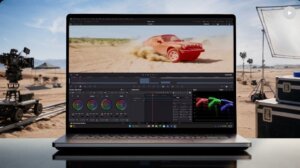
The integrated GPU and AI accelerators can support applications like video editing, 3D rendering, animation and other AI design tools. NVIDIA is collaborating with software firms like Adobe and Blender to fine-tune applications for it.
This will enable future RTX Spark laptops to be used as mobile workstations and gaming systems.
Battery Life & Efficiency
One of the most frequent problems with robust Windows laptops has always been battery life.
NVIDIA says that RTX Spark is the company’s most efficient PC chip ever produced. The integrated design enables high-performance workloads to operate more efficiently, while consuming less power.
Being Arm-based, the platform has a lot of efficiencies to gain from the Apple MacBook range and Windows laptops with Qualcomm.
Manufacturers will be expected to create systems with RTX Spark as thin as 14mm with all day battery life.
If NVIDIA’s claims are true with real-world usage, then this might finally bring down the gap between powerful Windows laptops and Apple’s super efficient MacBooks.
So who will benefit from the use of RTX Spark?
Many of the main manufacturers already have their commitment to the platform.
Expected partners include:
- Microsoft
- Dell
- HP
- Lenovo
- ASUS
- MSI
- Acer
- Gigabyte
But Microsoft has already demonstrated the architecture with devices, and there is strong industry backing. These systems with RTX Spark power are anticipated to be available in late 2026.
Conclusion
The Nvidia RTX Spark is more than just another laptop processor. It’s a bid by NVIDIA to completely re-invent the Windows laptop arena with AI acceleration, RTX graphics, Arm efficiency and a unified memory system.
The technology will deliver impressive local AI processing, impressive performance, advanced content creation capabilities and improved battery life compared to many Windows laptops. The specifications and industry support indicate that RTX Spark could be one of the most significant PC innovations of 2026, though it may not be until it enters the wild later this year.
With the future of the RTX Spark, laptops based on NVIDIA’s technology might eventually be able to take on Intel and AMD systems and may even impact the MacBook lineup, which could revolutionize the laptop design for years to come.