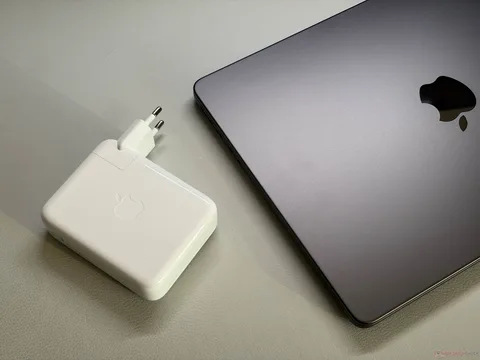
Apple has not resolved the inadequate power supply issue on the redesigned MacBook Pro 14 OLED either. Even when the power adapter is plugged in, the battery loses up to 15% an hour when it is heavily loaded.
Earlier this year, we reported on the MacBook Pro 14 and 16 that their power adapters could not meet their power requirements under full load. The smaller 14″ MacBook Pro and larger Macbook Pro 16 also needed to suck some extra juice from the battery when the load was heavy.
The problem is not with the power adapters themselves, but with artificial limits imposed by Apple. With more powerful adapters, you don’t get any additional power for the devices: The MacBook Pro 14 is capped at just under 100 watts, and the MacBook Pro 16 is capped at 145 watts. This problem has historical roots. The design of the MacBook Pro models with Mini-LED displays has remained unchanged for many years. The first generation of M-series SoCs only required a lot less power. The power consumption of the M5 Pro and M5 Max chips has, however, jumped up to an equally dizzying pace!
There had been high expectations that Apple would also do something about the less than satisfactory power supply when it replaces the LCD display with an OLED display on the new MacBook Pro. We got a 140-watt power adapter with our MacBook Pro review machine, but our measurement of the power was not all that great: The power adapter restricts the MacBook Pro to 96 watts. Consequently, the new model batteries have also become depleted under heavy load. Our review unit went down about 15% per hour when the CPU was fully loaded and the screen brightness was set to maximum.
We find it incomprehensible, and somewhat embarrassing for a company like Apple, that this problem has still not been resolved on a “Pro” device. After all, it’s not a MacBook Air, it’s a very high quality product at a starting price of $2,900.