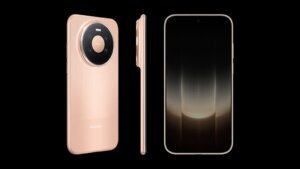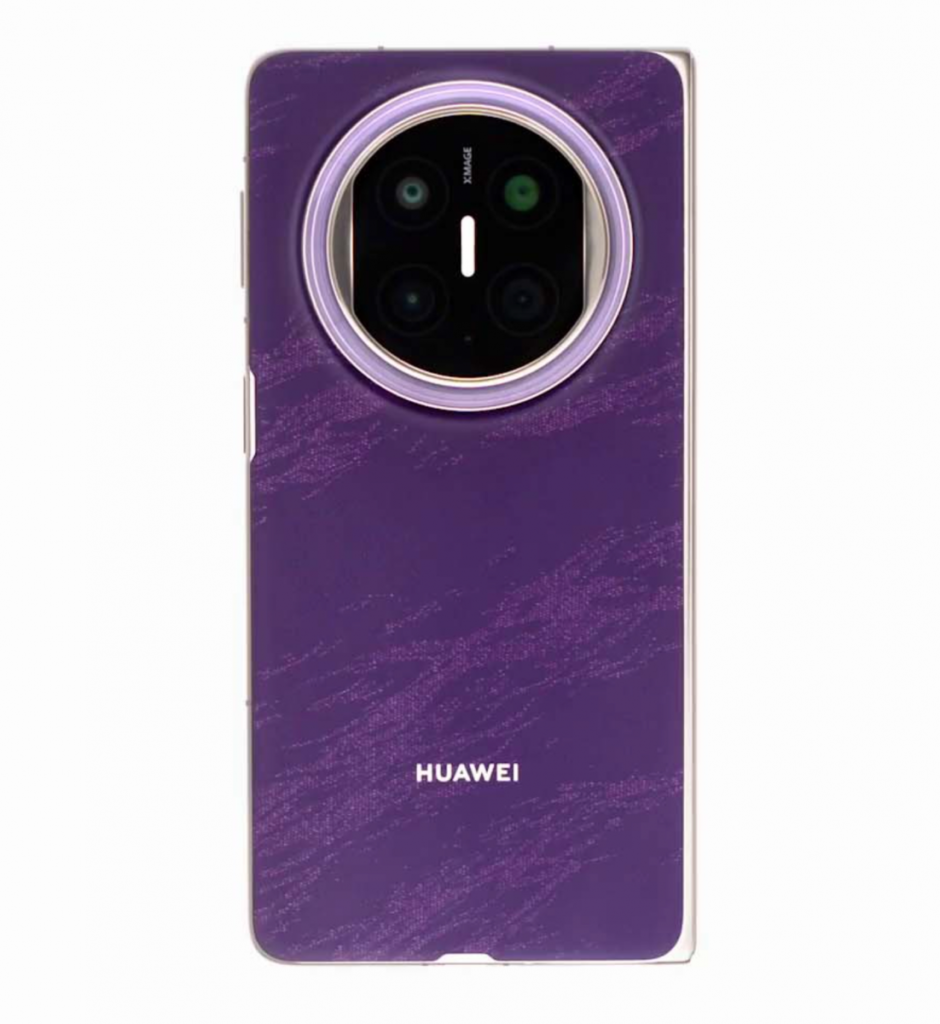
It’s official. Huawei has launched the Mate X8 in China — its new book-style foldable flagship — and the headline is not the price. At ¥12,999 (about $1,951), it costs exactly what the Mate X7 cost when it launched a year ago. What changed is everything around that price: a thinner body, a bigger battery, a brighter pair of screens, and a folding display Huawei says has almost no crease left.
Key facts
- Price: from ¥12,999 (~$1,951) for 12GB + 256GB; Collector’s Editions from ¥15,999 (~$2,402) up to ¥20,999 (~$3,152)
- Displays: 8.2-inch inner OLED (2,424 × 2,340, 1–120Hz LTPO) + 6.54-inch cover OLED, up to 12,000 nits peak brightness
- Chip: Kirin 9050 Pro — Huawei claims 31% higher overall performance than the Mate X7
- Battery: 6,200mAh, the largest Huawei has put in a single-fold phone; IP58/IP59 rated
- Cameras: 50MP main with variable aperture (f/1.49–f/4.0) + 40MP ultra-wide + 50MP 3.5x periscope; works with Huawei’s Ruiying Z10 modular camera
- Size: 4.2mm unfolded / 8.95mm folded; 239g
- Colours: five Brocade finishes, including Purple Gold Brocade and Danxia Brocade; HarmonyOS 7 out of the box
- On sale: pre-sales today at 18:08 China time; open sales December 4 at 10:08 China time
- Global launch: not announced — China only for now
Huawei unveiled the phone today, November 24, at its Mate X8 and all-scenario event in Beijing, alongside the Mate 90 Air and the Huawei Watch Air. Tech Mansion covered the launch date and reservations a week ago, when the price was still unknown — and the first official renders the week before that. Now the full picture is out, and the price is the pleasant surprise: Huawei held the line.
The crease is the story
Every foldable launch claims progress on the crease. Huawei’s claim this time is specific enough to be interesting: a new magnetic flattening system in the hinge, built around a 0.1mm magnetic composite, an aerospace-grade steel laminate and a 5-micron fill process. Huawei says the steel laminate raises bending stiffness by 140% and recovers 99.9% after bending, inner-screen flatness improves by 90%, and the crease height difference can be as low as 15 microns. A 9-layer anti-reflective coating on the inner display is rated at just 0.9% reflectance.
The claim had already been tested in public before the launch. A leaked hands-on video shared on November 18 showed a light purple Mate X8 unfolded outdoors and tilted at different angles under daylight — and the fold area showed almost no visible dip, even at the steep angles where creases usually stand out. Huawei’s own offline posters in China are built around three words: “Large, Bright and Flat.”
The honest caveat: a fresh unit under showroom light is the easy test. As GizmoChina noted, Samsung’s Galaxy Z Fold 8 looked nearly creaseless at launch, but its crease became noticeably more visible after a week of use — and Apple’s iPhone Duo hides its crease well at rest, but hands-on videos showed a dip you can feel. Reviewers will need to live with the Mate X8 for a week before anyone can call the crease solved. The crease race is also heating up elsewhere: Honor’s first wide foldable arrives in March 2027 with a CEO promise of “absolutely no creases”.
Two brighter screens
The inner display grows from 8 inches on the Mate X7 to 8.2 inches, with a roughly 1:1 aspect ratio, a 2,424 × 2,340 resolution, 1–120Hz LTPO adaptive refresh, 1,440Hz PWM dimming and an ultra-thin glass cover. Huawei rates it at 8,000 nits local peak brightness at 1% APL and 4,500 nits at 20% APL, and the screen can drop to 1 nit for night use.
The cover display is a 6.54-inch dual-layer OLED panel with a 2,444 × 1,132 resolution and a tall 19.4:9 aspect ratio. It reaches 12,000 nits at 1% APL and 6,000 nits at 20% APL, with 1–120Hz LTPO, HDR Vivid and 1.07 billion colours. Both screens, in other words, are brighter than the pair on the Mate X7 — and the cover screen’s 12,000-nit figure is one of the brightest numbers any phone maker has put on a spec sheet.
Huawei Mate X8 — confirmed specs
- Inner display: 8.2-inch OLED, 2,424 × 2,340, 1–120Hz LTPO, 1,440Hz PWM, up to 8,000 nits, ultra-thin glass
- Cover display: 6.54-inch dual-layer OLED, 2,444 × 1,132, 19.4:9, 1–120Hz LTPO, up to 12,000 nits, HDR Vivid
- Chip: Kirin 9050 Pro Logic Folding Tau (also in the Mate XT 2 tri-fold)
- RAM / storage: 12GB + 256GB · 12GB + 512GB · 16GB + 512GB (Collector’s) · 16GB + 1TB (Collector’s) · 16GB + 2TB (Collector’s)
- Battery: 6,200mAh; IP58 + IP59 rated
- Rear cameras: 50MP main, variable aperture f/1.49–f/4.0, LOFIC + RYYB · 40MP ultra-wide (RYYB) · 50MP 3.5x periscope telephoto (OIS) · Red Maple multispectral sensor · XMAGE
- Modular camera: supports the Ruiying Z10 — a 1-inch 50MP RYYB unit with Red Maple sensor and OIS
- Thickness / weight: 4.2mm unfolded, 8.95mm folded / 239g
- Cover glass: 3rd-gen Kunlun Glass (standard); 2nd-gen Xuanwu Kunlun Glass (Collector’s Edition)
- Software: HarmonyOS 7
- Colours: Purple Gold Brocade, Azure Sky Black, Snowy White, Qingyun Brocade, Danxia Brocade
Mate X7 vs Mate X8: what actually changed
Year over year, this is a bigger upgrade than the unchanged starting price suggests. The one number that goes the wrong way is the weight — and it is worth saying plainly.
| Mate X7 (Nov 2025) | Mate X8 (Nov 2026) | |
|---|---|---|
| Price from | ¥12,999 | ¥12,999 — unchanged |
| Thickness unfolded | 4.5mm | 4.2mm |
| Thickness folded | 9.5mm | 8.95mm |
| Weight | 236g | 239g — 3g heavier |
| Inner display | 8.0-inch | 8.2-inch |
| Cover display | 6.49-inch | 6.54-inch |
| Chip | Kirin 9030 Pro | Kirin 9050 Pro |
| Battery | ~5,500mAh | 6,200mAh |
Huawei calls the Mate X8 lighter than any earlier Mate X phone, but the numbers say otherwise: at 239g it is 3g heavier than the 236g Mate X7. The extra grams buy a 700mAh bigger battery and a larger inner screen, so it is a fair trade — just not the one Huawei’s marketing describes.
Kirin 9050 Pro and the biggest foldable battery
Every Mate X8 runs the Kirin 9050 Pro Logic Folding Tau, the same chip Huawei uses in the Mate XT 2 tri-fold. Huawei claims 31% higher overall performance than the Mate X7, with a 30% higher transistor count, a 9-core, 16-thread LinxiCore CPU with 23% higher multi-core performance, a Maleoon GPU with second-generation ray tracing and 40% higher rendering performance, and a Da Vinci NPU that is 140% faster. It is the same silicon story as the Mate 90 Pro Max — a proper flagship chip, not the cut-down silicon Huawei put in the thin Mate 90 Air.
The battery is the other headline: 6,200mAh, which Huawei says is the largest it has ever put in a single-fold device, up from about 5,500mAh on the Mate X7. The phone is also rated IP58 and IP59 for dust and water. Huawei has merged the cellular and Wi-Fi antennas, raising antenna area threefold and signal strength by 2dB — a small detail that should help in weak-signal areas, where foldables have traditionally struggled.
The camera Huawei calls its best in a foldable
Huawei claims the Mate X8 has the best camera system ever put in a foldable, and the hardware backs up the boast. The main camera is a 50-megapixel unit with a variable aperture from f/1.49 to f/4.0, LOFIC technology for dynamic range and an RYYB filter for low light — with the larger 1/1.28-inch sensor on the higher models. The ultra-wide is 40 megapixels, also with RYYB, and the periscope telephoto is 50 megapixels with 3.5x optical zoom, optical image stabilisation and close-up shooting. A multispectral Red Maple sensor handles colour accuracy, and the whole system runs on Huawei’s XMAGE imaging.
Then there is the party trick: every Mate X8 supports Huawei’s Ruiying Z10 modular camera, a 1-inch 50-megapixel RYYB unit with a Red Maple sensor and its own optical image stabilisation. Huawei is offering a kit with the module, a control handle and a HyperClick connector shell — effectively a clip-on camera for a phone that already has one of the strongest camera systems in a foldable. Tech Mansion first reported the 10x zoom module rumour before launch; the real thing is a 1-inch sensor, not a 10x zoom, but the idea survived intact.
Huawei’s Richard Yu called the Mate X8 “the most innovative large foldable the company has made.” On the spec sheet, that is a defensible claim — the question, as with the crease, is how it holds up once reviewers get their hands on it.
Price, colours and when you can buy it
The full price list, all from Huawei’s official store:
| Model | Price | About |
|---|---|---|
| 12GB + 256GB | ¥12,999 (~$1,951) | Standard, all five colours |
| 12GB + 512GB | ¥13,999 (~$2,102) | Standard, all five colours |
| 16GB + 512GB Collector’s Edition | ¥15,999 (~$2,402) | Xuanwu Kunlun Glass |
| 16GB + 1TB Collector’s Edition | ¥16,999 (~$2,552) | Xuanwu Kunlun Glass |
| 16GB + 2TB Collector’s Edition | ¥20,999 (~$3,152) | Purple Gold Brocade and Azure Sky Black only |
Pre-sales for the first four models start today at 18:08 China time, with open sales at 10:08 China time on December 4. The 2TB model goes on open sale at 10:08 China time on December 20. Huawei is offering up to 12 months of interest-free installments and a trade-in subsidy of up to ¥800 (about $120) at Vmall, authorised e-commerce sites, Huawei experience stores and authorised retailers.
International availability has not been announced, and Huawei phones are not sold officially in the US. But there is a precedent worth watching: last year the Mate X7 reached Dubai about a month after its China debut. If Huawei repeats that plan, the Mate X8 could reach global buyers within weeks. Until then, the crease and the full global price list are the numbers to watch.
Huawei Mate X8 — questions answered
How much does the Huawei Mate X8 cost?
From ¥12,999 (about $1,951) for the 12GB + 256GB model. The 12GB + 512GB model is ¥13,999 (about $2,102), and the Collector’s Editions run from ¥15,999 to ¥20,999 (about $2,402 to $3,152).
When can I buy the Mate X8?
Pre-sales in China start today, November 24, at 18:08 China time. Open sales begin December 4 at 10:08 China time, except the 16GB + 2TB Collector’s Edition, which goes on sale December 20.
Is the Mate X8 coming to the US, Europe or other global markets?
Huawei has not announced international availability. Last year the Mate X7 reached Dubai about a month after its China debut, so a global launch within weeks is possible — but nothing is confirmed yet.
Is the crease really gone?
Huawei claims the crease height difference can be as low as 15 microns thanks to a new magnetic flattening hinge system, and a pre-launch hands-on video showed almost no visible dip. Independent reviewers still need to test it over days of real use before the claim is proven.
What is the Ruiying Z10 camera?
A modular 1-inch 50-megapixel RYYB camera with a Red Maple sensor and its own optical image stabilisation, which clips onto any Mate X8. Huawei sells it as a kit with a control handle and a HyperClick connector shell.
How is the Mate X8 different from the Mate 90 Air launched at the same event?
The Mate X8 is Huawei’s book-style foldable flagship — 8.2-inch folding screen, Kirin 9050 Pro, from ¥12,999. The Mate 90 Air is a thin bar phone — 6.58mm thick, 7-inch screen, Kirin 9020, 6,500mAh battery, from ¥4,999.
Watch: why phone batteries are finally getting bigger
Tech Mansion on the battery race — the Mate X8’s 6,200mAh cell is the largest Huawei has put in a single-fold phone.