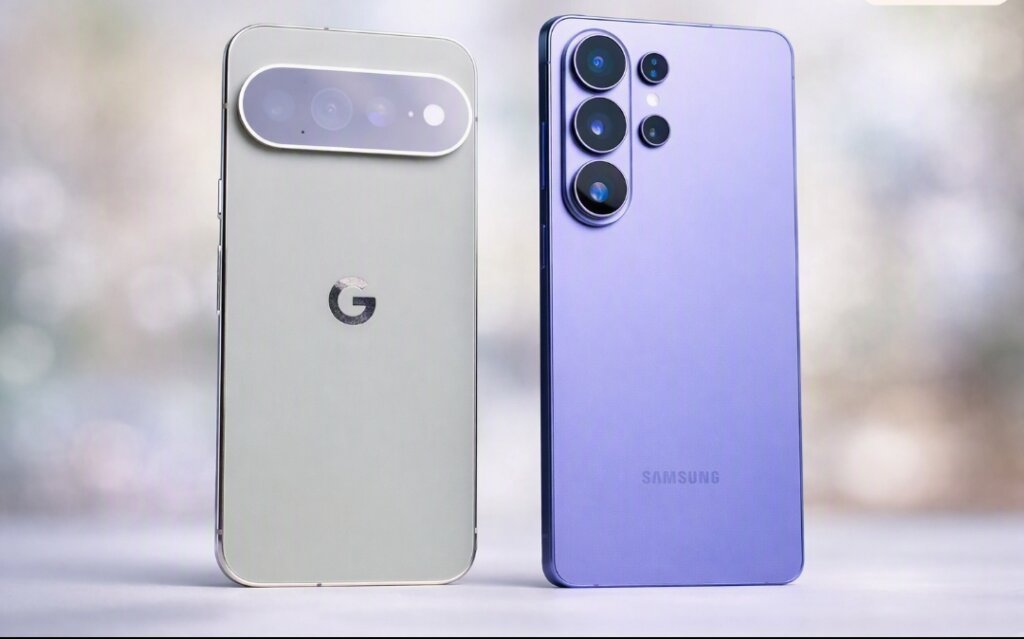
Google and Samsung are going head-to-head again in the premium Android smartphone market. The Pixel 11 Pro XL is Google’s newest expression of smartphone photography, AI and clean Android software, and the Samsung Galaxy S26 Ultra is Samsung’s most recent expression of display technology, camera versatility, performance and productivity capabilities.
They’re both high-dollar flagship phones, but they have slightly different focuses. The Google Pixel 11 Pro XL vs Samsung Galaxy S26 Ultra comparison, therefore, is less about size of specs and more about which phone suits your requirements.
Here’s how the two flagship Android phones compare.
Design and Display
Pixel 11 Pro XL has a big 6.8-inch Super Actua LTPO OLED display that can deliver 120Hz refresh rate at 1344 x 2992 resolution. The display can peak up to 3,600 nits, which is higher than many displays in the market and is great for outdoor use, Google says.
Galaxy S26 Ultra also features a 6.9” screen, but Samsung’s Galaxy S26 Ultra features a QHD+ Dynamic AMOLED 2X panel. The phone has a 120Hz adaptive refresh rate and reaches up to 2,600 nits of outdoor brightness.
Another feature Samsung is adding to its Galaxy Tab is a built-in Privacy Display, which can restrict visibility from certain angles. This is a useful feature if you frequently use your phone in public places.
Both screens are excellent for streaming, gaming and everyday use. Google’s display has the highest quoted peak brightness, Samsung has a higher QHD+ resolution and its privacy screen technology is uncommon.
Read Also: Pixel 11 Pro XL Price in Nigeria: Expected Cost and Release Date
Performance
Google’s Tensor G6 processor is used in the Pixel 11 Pro XL. Google has taken the approach of putting a lot of emphasis on AI and on-device processing rather than just trying to hit benchmark figures with this chip.
Google states that Tensor G6 delivers a 25% performance boost in browsing the web and a 15% faster app launches than Tensor G5. It also offers a much greater TPU performance for AI workloads.
Galaxy is powered by Samsung’s Snapdragon 8 Elite Gen 5. The processor is also optimized for high CPU and GPU performance, as well as for heavy AI workloads. Samsung claims that the previous generation has been improved by as much as 19% in terms of CPU performance.
The Snapdragon platform is more performance-oriented for gaming and demanding applications. Google’s Tensor G6, on the other hand, is more focused on Google’s AI capabilities and the software used on the Pixel.
Camera Comparison
One of the most significant differences between these cameras is their performance.
The Pixel 11 Pro XL features a triple-camera setup with a new primary camera sensor, a 48MP telephoto lens and an ultrawide lens. Google claims that the telephoto sensor captures 30% more light than the previous generation and can have up to 120x Pro Zoom.
Google also mentions enhancements to Night Sight, which, the company claims, makes it possible to capture images up to 4.5 times faster.
Samsung has a more aggressive hardware policy. The Galaxy S26 Ultra features a 200MP main camera, a 50MP ultrawide camera, a 50MP telephoto camera with 5x optical zoom and a 10MP telephoto camera with 3x optical zoom.
This makes Samsung’s setup with varying focal lengths quite flexible.
Google’s computational photography and AI processing is the Pixel’s forte, and Samsung has a wide camera system, including multiple dedicated lenses and powerful zoom capabilities.
Read More: Galaxy S26 Ultra vs Pixel 10 Pro XL: Which One Is Cheaper?
Battery and Charging
Pixel 11 Pro XL’s typical battery capacity is 5,115mAh, and Google estimates are over 30 hours of battery life. The device also has 45W wired charging, Google states that this will charge the device up to 75% in about 30 minutes with a compatible charger.
Galaxy S26 Ultra also has a 5,000mAh battery. Samsung benchmarks it for up to 31 hours of video playback and claims it can get 75% charged up in approximately 30 minutes, under its tests.
For most people, both phones should last long enough for a full day, but for some, given factors like screen brightness, gaming, mobile data, camera usage, etc., the battery life can vary.
AI and Software
This is where Google’s Pixel approach gets really interesting.
Google’s version of Android is integrated with the Pixel 11 Pro XL’s Gemini experience. Google has added more AI features to boost productivity, photography, communication and general daily life. The handset also gets seven years of operating system, security and Pixel Drop updates.
Samsung uses its own One UI software on top of Android and has built Galaxy AI into the S26 Ultra. Samsung’s latest AI features are designed to perform more actions across applications and help users complete tasks using natural language.
The built-in S Pen also gives Samsung a significant productivity edge.
For those who prefer handwritten notes, drawing, editing documents and making extensive use of their phones for productivity, the S Pen can make the S26 Ultra more versatile than a traditional smartphone.
Storage and Price
The Pixel 11 Pro XL will launch at $1,299 for the 256GB version in the United States. Google provides other storage alternatives, depending on markets.
The Galaxy S26 Ultra also begins at roughly $1,299 in the United States at 256GB, making it in the same high-end pricing tier as the Galaxy S26. Samsung’s 512GB and 1TB options are also available.
Actual prices may vary significantly from U.S. prices due to exchange rates, import costs, retailer margins, and availability in Nigeria. Buyers need to make price comparisons in order to make their decision.
Which One Should You Buy?
Google Pixel 11 Pro XL vs Samsung Galaxy S26 Ultra commends to the reader.
Pixel 11 Pro XL is a nice choice for the Google mantra of Android, computationally-driven photography, the use of Gemini AI and a promise of long-term software updates. It is especially attractive to photography enthusiasts and those who favor Google’s rendition of Android as its camera system and clean software experience.
The Galaxy S26 Ultra is designed for users who want a more feature-packed flagship. It is a very versatile device with its 200MP main camera, several telephoto lenses, QHD+ display, S Pen and the plethora of Galaxy AI features.
Also, Samsung has a wider range of hardware, in addition to the Galaxy Tab series, the Galaxy Watch active, the Galaxy Buds Air, and the Galaxy Book tablet, which is now available in both 12.6 and 12.5-inch models. Google’s Pixel ecosystem is also widening with its Pixel watch and earbuds.
Final Verdict
Google Pixel 11 Pro XL vs Samsung Galaxy S26 Ultra comparison reveals two contrasting approaches to premium Android phones.
Google’s focus is on AI, computational photography and a clean software experience. Samsung emphasizes versatility in hardware, flexibility in the camera, display technology, productivity and customization.
For those who value photography processing, Google’s AI technologies and the Android long-term support, the Pixel 11 Pro XL offers more to them.
For high resolution, zoom cameras, S Pen and customization, the Galaxy S26 Ultra might be more suitable.
Both phones are not necessarily the better choice for all users. They’re both potent 2026 flagships, and your current system, camera tastes and software workflow should be a key factor in deciding which one should be in your pocket.