Your Tesla’s screen no longer shows a cartoon of the road. It draws the road itself — live, in photorealistic detail, as the car drives. That is the headline change in Tesla’s Full Self-Driving (Supervised) v15, which started rolling out on Saturday, November 21, and it comes with the boldest safety claim Tesla has ever attached to an update: 25 times better handling of safety-critical cases. The catch is that Tesla has not shown the numbers behind that claim — and not every Tesla will get this update at all.
Key facts
- The rollout: FSD (Supervised) v15.0.1 began rolling out on Saturday, November 21, 2026, in software update 2026.38.6.11, starting with a small early-access wave in the US
- The headline feature: Tesla Reality View — a live, AI-generated view of the street around the car, rendered from a virtual camera above it
- The headline claim: “25x better handling of safety critical cases” — Tesla’s claim, from a new vision encoder. Tesla has not published the underlying intervention rate, so it cannot yet be independently verified
- Who gets it: Hardware 4 / AI4 cars first, with the first wave reported on the redesigned Model Y in the US and Canada. HW3 cars do not get v15 — they stay on FSD v14 Lite
- The price: $99 a month in the US. The $8,000 one-time purchase ended on February 14, 2026, so FSD is now subscription-only
- Wide release: Elon Musk says v15 goes to wide release in December, expected with the holiday update — his promise, with no exact date yet
Reality View: the car draws the world around it
The most visible change in v15 is the one drivers will see every time they switch FSD on. The old visualisation drew the cars, lanes and objects FSD detected as simple computer graphics. Reality View replaces that with a realistic, generated video of the car’s surroundings, seen from a virtual camera floating above the car — buildings, sidewalks, parked cars and people included, with chevrons floating in the sky for upcoming turns.
Under the hood, it is not a video game engine and not stitched camera footage. Tesla stitches the car’s camera feeds together and maps each pixel onto a 3D stage that matches where that pixel sits relative to the vehicle, then generative AI fills in the gaps. The result is a live picture of the street that also shows what FSD is planning to do: the blue path and arrows on screen are the car’s intended route, not decoration. Musk called it “real-time AI video generation (no gaming engine!)” and said it runs on just half of one of the AI4 computer’s accelerators. The view comes in fullscreen, map-overlay, split and quiet modes, and you can tap a point on the screen to direct the car there.
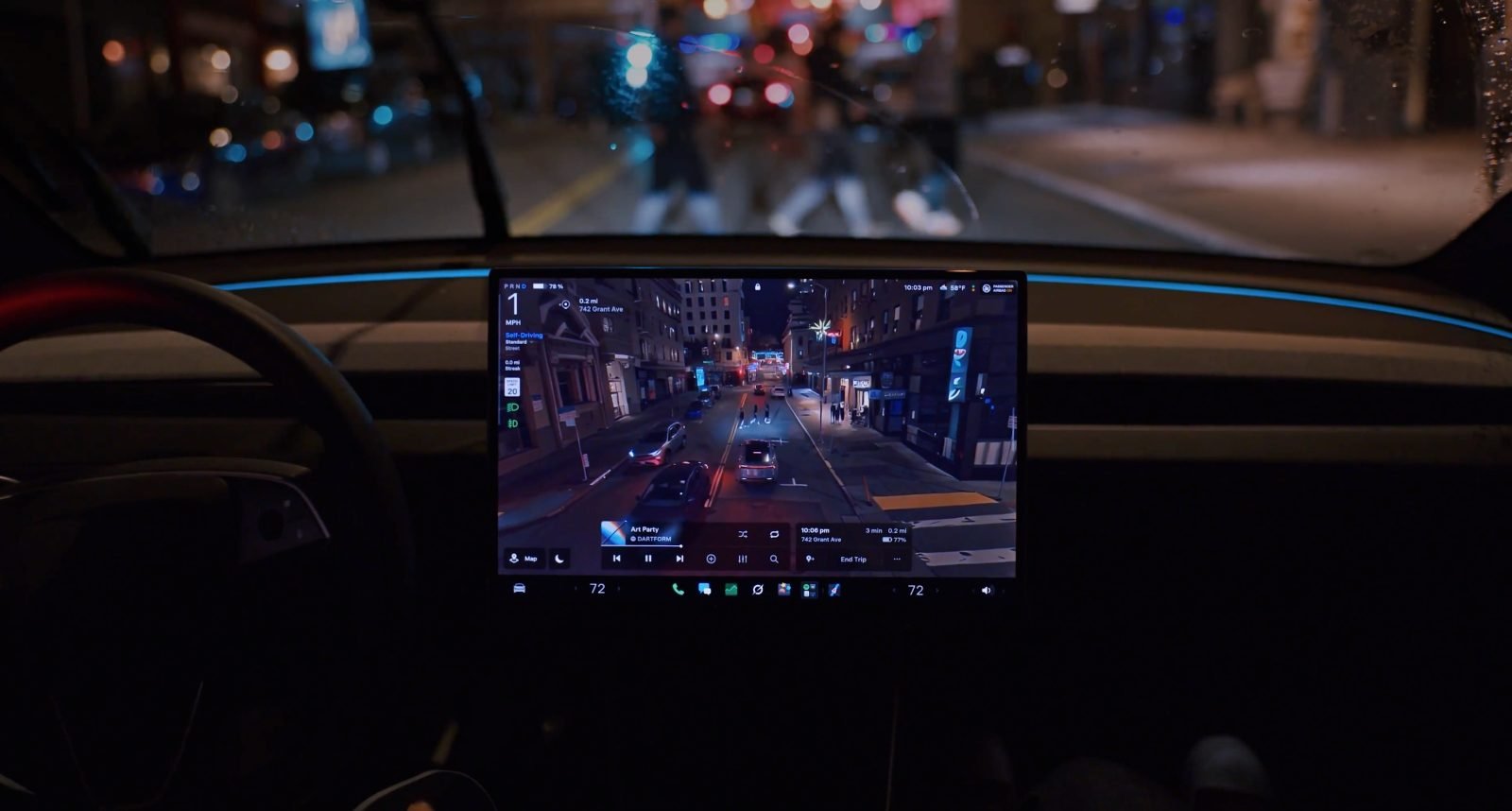
It is worth knowing what the view is and is not. It is generated from the same end-to-end network that drives the car, so it reflects what the car thinks is there. Tesla’s VP of AI software, Ashok Elluswamy, says the new visualisation actually needs less computing power than the old blocky display. Musk, meanwhile, has been candid that its latency is “a bit high due to compute constraints” — the early clips look stunning, but a few owners note the picture can lag a beat behind the real world. That tension runs through this whole update, and we come back to it below.
The 25x claim — and why it needs a caveat
Tesla is leading with one number: 25 times better handling of safety-critical cases. The fuller release notes credit a new vision encoder, shared between FSD, the Robotaxi service and the Optimus humanoid robot, trained on millions of internet videos — and Tesla says it improved the critical intervention rate by 25 times. That is the rate at which the system needs a driver to take over in a genuinely dangerous situation.
Here is the problem with taking the number at face value: Tesla published the multiplier but not the underlying intervention rate, and has not said what the 25x is measured against, over how many miles, or how it defines a critical intervention. Without the baseline, no one outside Tesla can check the maths. A Tesla self-driving lead, Phil Duan, put it more bluntly on X, writing that “v15 is 25x safer than v14 across the fleet” — but that is the same company figure, not independent proof. Treat 25x as Tesla’s claim until real-world data lands. What would actually settle it is the one number Tesla has not shared: how many miles v15 drives between critical interventions, compared with v14.
What else is new in FSD v15
Reality View gets the attention, but v15 touches nearly every part of the driving stack. The full release notes, as reported from owner cars, add up to a long list:
Everything new in v15
- Bike Rack Mode: FSD keeps working with a bike rack (or anything else) attached to the car — and can now reverse and park at your destination with it fitted
- Speed camera slowdown: the car now slows for speed cameras. You can override it by accelerating, and after two overrides at the same camera, FSD remembers the spot and stops slowing there
- Route learning: navigation learns preferences from Tesla’s fleet — starting with the beginning and end of trips, with the full route coming in later v15 revisions
- Smarter parking: parking selection learns from your own parking history, and the car improves how it leaves car parks and parks at your destinations
- Better detection: road signs, small animals, debris, chains, potholes and standing water are all detected more reliably, with speed handling refined for school zones, changing weather and different driving profiles
- Quieter signals: turn signal sounds are quieter and fade after several clicks while FSD is enabled
Two of those matter more than they look. Route learning means the car starts to drive like the fleet drives — including the quirks of how real owners take a particular junction or leave a particular car park — rather than following one fixed policy everywhere. And speed camera slowdown is the kind of small, practical change owners notice on day one: the car easing off before a camera, instead of the driver having to intervene.
FSD v15 vs FSD v14 Lite: who gets what
The split between Tesla’s two hardware generations is now a hard line. v15 is built for the AI4 computer; cars on the older Hardware 3 computer do not get it at all — not even a cut-down version of v15. Here is where things stand:
| FSD v15 (AI4 / HW4) | FSD v14 Lite (HW3) | |
|---|---|---|
| Reality View | Yes — live AI-generated view | No |
| 25x intervention claim | Yes — new vision encoder | No |
| Bike Rack Mode, speed camera slowdown, route learning | Yes | No |
| Who gets it | AI4 cars, starting with the redesigned Model Y in the US and Canada | HW3 cars stay here |
| Future updates | Full v15 line going forward | v14 Lite is the end of the road unless the hardware is upgraded |
That last row is the one HW3 owners will feel. Musk has now said plainly that the next-generation AI5 chip is going to the Optimus robot, not to cars — “Cars will remain at AI4. That’s enough to solve superhuman driving.” For years, some HW3 owners held out hope that Tesla was delaying their hardware upgrade until AI5 arrived. That excuse is now gone, and Tesla has not said when — or whether — HW3 cars will be offered an upgrade path.
Who gets v15, and when
The rollout started on Saturday with the first wave of customers, and Tesla’s head of AI software said it was going to “the first wave of customers”. Reports so far suggest the first cars are the redesigned Model Y — late 2025 or 2026 models — in the US and Canada, and the rollout is going out beyond just early-access testers already. Tesla has not said which models or countries are in the first wave, and updates roll out gradually rather than on request.
The wider release is where Musk has put a date on it: v15 “goes to wide release next month”, expected with Tesla’s annual holiday update in December. That is Musk’s promise, not a confirmed date — and Tesla’s holiday update has slipped before. If you own an AI4 car, the practical advice is to make sure the car is set to receive updates and wait; there is no way to request v15 directly. If you own an HW3 car, v15 is not coming to it, and the question to watch is whether Tesla offers a hardware upgrade — something it has not announced.
The other side: AI4 is nearly out of room
For all the excitement, v15 arrives with a warning baked in — from Musk himself. Over the weekend he spent hours on X explaining how the software uses the AI4 hardware, and the picture is of a chip with almost nothing left in reserve. Reality View runs on half of one of the AI4 computer’s three TRIP accelerators on one of its two chips — half an accelerator is what was left over after Tesla moved a decoder into SRAM. Musk admitted the visualisation’s latency is “a bit high due to compute constraints”, and described Reality View as a roughly one-billion-parameter diffusion model running off the same vision encoder features that feed the 3-billion-parameter model producing the driving actions.
That matters because of what unsupervised driving needs. When Tesla unveiled its FSD computer in 2019, the selling point was redundancy: two independent chips, each able to take over if the other failed. With nobody in the driver’s seat, a hardware fault cannot simply hand control back to a human — the car needs enough healthy compute left to keep seeing the road and pull over safely. Musk’s own description shows the second chip running the decoder and the Reality View model, not sitting idle as a mirror of the first. Tesla has never explained how much of AI4 it reserves for failover, or whether a single chip can run enough of the stack to bring a car to a safe stop on its own.
The mid-cycle refresh does not rescue the picture either. AI4.5 was announced as a RAM doubling from 16GB to 32GB per chip; this weekend Musk said it had been cut back to 24GB because “RAM is super expensive”, and that AI4 “costs twice as much now due to memory and storage price hikes”. And AI5, the next-generation chip at roughly 12 times the compute of AI4, is going to Optimus and data centres — not to cars. As Electrek puts it, if v15 cannot get to unsupervised driving on AI4, there is no hardware escape hatch for the fleet.
v15 also arrives while US regulators are still examining FSD. The National Highway Traffic Safety Administration upgraded its probe into FSD in low-visibility conditions to a full engineering analysis covering about 3.2 million vehicles in March 2026, and that investigation is still open.
What people are saying
The first owner clips are, unsurprisingly, almost all about Reality View. The early videos show the new parking spot selection and the floating arrows as much as the driving itself — the visual features, not the intervention numbers. That is the honest state of the evidence right now: nobody outside Tesla has driven v15 far enough to say whether the 25x claim holds up. Electrek’s take is blunt — Reality View looks great, but it is visibly laggy and Musk admits it is compute-limited: “A great visual update is nice. Driving performance is what matters.”
The fairest verdict for now is to split the two halves of v15. Reality View is real, it is on customer cars today, and it changes what the driver sees more than any FSD update before it. The safety claim is a promise that only miles will verify — and the hardware it runs on is, by Musk’s own account, nearly full.
Tesla FSD v15 questions, answered
When will I get FSD v15?
It started rolling out on November 21, 2026, to a small first wave — reported on the redesigned Model Y in the US and Canada. Musk says wide release comes in December with the holiday update. Tesla rolls updates out gradually and does not send them on request, so AI4 owners should simply make sure their car is set to receive updates.
Does my Hardware 3 Tesla get FSD v15?
No. HW3 cars do not get v15 at all — they stay on FSD v14 Lite, which Tesla describes as the end of the road for those cars unless the hardware is upgraded. Tesla has not announced an HW3 upgrade path.
How much does FSD cost now?
$99 a month in the US. The $8,000 one-time purchase ended on February 14, 2026, so FSD is now subscription-only.
Is the car self-driving now?
No. FSD (Supervised) is a Level 2 driver-assistance system: the driver must watch the road and be ready to take over at any moment. Reality View shows what the car plans to do, but it does not make the car autonomous.
What is Tesla Reality View?
A live, AI-generated view of the street around the car, rendered from a virtual camera above it. Tesla stitches the camera feeds together, maps each pixel onto a 3D stage, and generative AI fills in the gaps. It shows what FSD is planning — including upcoming turns — and you can tap a point on screen to direct the car there.
Tech Mansion’s own full video breakdown of FSD v15 is on the way — the 4K cut is finished and approved, and it walks through Reality View, the 25x claim and the HW3 split on the road. We will link it here as soon as it is live.