Samsung just made the fastest gaming monitor ever — and it costs $899.99
The 27-inch Odyssey G6 refreshes its screen 1,100 times a second, a world first. It goes on sale in the US in December — but the headline speed comes with a catch every buyer should understand first.
Key facts
- The launch: Samsung has officially launched the 27-inch Odyssey G6 (G60H), the world’s first gaming monitor to support a refresh rate of up to 1,100Hz, according to Samsung’s own newsroom.
- Price and date: $899.99 in the US, on sale at retailers nationwide in December 2026. SamMobile confirms the price and the December window; Amazon already lists it at $893.11 for pre-order.
- The catch: 1,100Hz only works in HD mode (1,280 x 720). At the monitor’s native QHD resolution (2,560 x 1,440), the maximum is 600Hz — still far faster than almost any monitor on sale.
- The panel: 27-inch Fast IPS, 1ms grey-to-grey response time, 178-degree viewing angle, 400 nits brightness, 99% sRGB, HDR10+ Gaming.
- Also inside: a new Odyssey Clear Motion blur-reduction feature, AMD FreeSync Premium and NVIDIA G-Sync compatibility, one DisplayPort 2.1 and two HDMI 2.1 ports.
- Outside the US: pricing varies by market — UK pricing is reported at £769.99, with no exact date confirmed yet.
Samsung has officially put a price and a date on the fastest gaming monitor ever made. The Odyssey G6 (G60H), announced on Monday, November 23, is a 27-inch monitor that can refresh its picture 1,100 times per second — a new record for a gaming display, and the first time any monitor has crossed into four-digit refresh rates.
It goes on sale in the United States in December 2026 for $899.99, SamMobile reports, and it is already up for pre-order on Amazon at $893.11, slightly below the official price, with a listed release date of November 24.
The headline number is real. But it is not the whole story — and Samsung is upfront about that in its own announcement. The 1,100Hz mode only works when the monitor drops its resolution to HD. Understanding that trade-off is the difference between buying the right monitor and buying a number on a box.
How Dual Mode works — two monitors in one
The Odyssey G6 is built around a feature Samsung calls Dual Mode. With one switch, the monitor changes both its resolution and its refresh rate, giving you two very different displays depending on what you are playing:
| QHD mode | HD mode | |
|---|---|---|
| Resolution | 2,560 x 1,440 (QHD) | 1,280 x 720 (HD) |
| Max refresh rate | Up to 600Hz | Up to 1,100Hz |
| Best for | Open-world and story games, everyday use — sharper picture | Competitive shooters — raw speed above all |
| Frame interval | About 1.67ms per frame | About 0.91ms per frame |
The idea is simple. In a slow, beautiful game, you want the sharper QHD picture. In a competitive shooter, where spotting an enemy a fraction of a second earlier matters more than scenery, you trade three-quarters of the pixels for speed. Samsung’s own words, from Hun Lee, Executive Vice President of its Visual Display business: “With the Odyssey G6, we are bringing together an ultra-high refresh rate and enhanced motion clarity, while enabling gamers to toggle between display modes depending on their gaming preferences.”
To put the numbers in context, here is where the G6 sits against the monitors most gamers actually own:
Even the “slow” mode is extraordinary. At 600Hz in QHD, the G6 refreshes more than twice as fast as a 240Hz gaming monitor — and most monitors on sale today top out at 144Hz or 165Hz. The previous speed king, LG’s UltraGear 25G590B, maxes out at 1,000Hz. Samsung has beaten it by 100Hz.
The 1,100Hz catch — read this before you buy
That is the point the enthusiast press has been making since Samsung first showed the monitor. Hardware Busters put it bluntly: what actually ships is “a 600Hz QHD monitor that throws away three quarters of its pixels to put a four-digit number on the box.” At 27 inches, 720p works out to roughly 54 pixels per inch — visibly soft if you sit close.
But the same coverage is fair about who this is for. Plenty of Counter-Strike 2 and Valorant players already run their games below their panel’s native resolution and would take the extra frames without blinking. For them, the 1,100Hz mode is a setting they will genuinely use, not a marketing line. And there is one technical saving grace: 720p doubles cleanly into 1440p, so the scaler’s job is easy and edges stay crisp instead of smeared.
The practical route to actually feeding 1,100Hz is frame generation — technology such as NVIDIA’s DLSS, which synthesises extra frames between the ones the card renders. The Gadget Flow’s verdict sums up the dilemma well: the G6 “wins on paper for pure refresh-rate bragging rights, but G8 is the more reasonable choice” for anyone who plays competitive games alongside anything else.
Full specifications
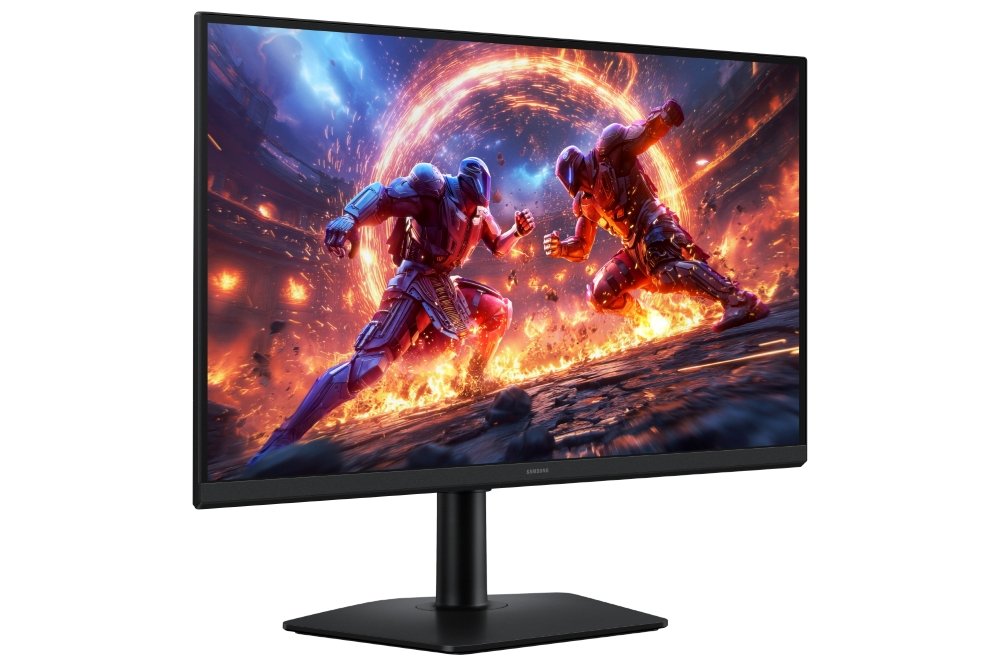
| Spec | Samsung Odyssey G6 (G60H) |
|---|---|
| Screen size | 27-inch, flat |
| Panel | Fast IPS LCD |
| Resolution | QHD 2,560 x 1,440 (native) |
| Refresh rate | Up to 600Hz at QHD / up to 1,100Hz at HD (1,280 x 720) via Dual Mode |
| Response time | 1ms grey-to-grey |
| Viewing angle | 178 degrees |
| Brightness | 400 nits (typical) |
| Colour | 99% sRGB |
| HDR | HDR10+ Gaming, Black Equalizer |
| Motion | Odyssey Clear Motion blur reduction (new — Samsung plans to bring it to more monitors) |
| Sync | AMD FreeSync Premium, NVIDIA G-Sync Compatible |
| Ports | 1x DisplayPort 2.1, 2x HDMI 2.1 |
| Extras | Auto Source Switch+, Virtual Aim Point crosshair overlay |
| Stand | Height, pivot, swivel and tilt adjustable (stops short of full portrait rotation) |
| Price (US) | $899.99 MSRP; $893.11 on Amazon pre-order |
| Availability | US retailers nationwide from December 2026; other markets to follow |
A few fine-print details from Samsung’s announcement are worth knowing. macOS does not support Dual Mode or the native 600Hz maximum — Mac users get a much slower monitor. AMD FreeSync Premium does not operate at 1,100Hz, and some older Radeon graphics cards cannot reach 1,000Hz or higher at all. And HDR10+ Gaming works over HDMI 2.1 with NVIDIA and Intel graphics cards — Samsung notes it is not supported on AMD GPUs.
From 1,040Hz prototype to $899.99 on shelves
The G6 did not appear overnight. Samsung has been building up to this launch all year:
- December 2025: Samsung first teases the Odyssey G6 as part of its 2027 Odyssey lineup, with a 1,040Hz headline figure.
- January 2026 (CES): the monitor is shown on the show floor running at 1,040Hz in HD mode and 600Hz at QHD.
- August 2026 (Gamescom): Samsung raises the final specification to 1,100Hz and unveils the full 2027 Odyssey range, including three new OLED models.
- November 23, 2026: Samsung confirms the US launch — $899.99, on sale in December — and opens pre-orders, with Amazon listing it at $893.11.
- December 2026: US retail rollout begins. Pricing and timing for other markets, including the UK (£769.99 reported), are still to be confirmed.
The launch also extends Samsung’s run at the top of the gaming monitor market — the company has led the global gaming monitor market for seven consecutive years, from 2019 through 2025, according to IDC figures cited in its announcement. It is the same Samsung display business behind the screens in rival phones, which is why the monitor line matters to the company far beyond gaming.
Who should buy it — and who should skip it
Buy it if: you play competitive shooters seriously, you already own a high-end graphics card (or plan to use frame generation), and you are happy to drop to 720p for ranked matches while enjoying a superb 600Hz QHD monitor the rest of the time. At $899.99, you are paying flagship money for flagship speed.
Skip it if: you mostly play story-driven or open-world games, where resolution and image quality matter more than refresh rate — a 4K 144Hz or QD-OLED monitor will look dramatically better for the same money. Skip it too if you are on a Mac, since macOS cannot use Dual Mode or the 600Hz maximum, or if your graphics card cannot push several hundred frames per second in the games you actually play.
Wait if: you are outside the US. Samsung has confirmed the American price and date, but pricing for Europe and other markets is still unconfirmed — and with the holiday season coming, the $899.99 tag may not stay put for long. SamMobile notes you might even find it cheaper than $899 once it is on shelves.
Samsung is feeling the same cost squeeze as the rest of its hardware business this year — rising memory prices have already pushed Galaxy S27 prices above Samsung’s original targets, and the company has reportedly paused new Galaxy Watch launches for 2027 to cut costs. Against that backdrop, launching the world’s fastest monitor at under $900 — cheaper than many expected — looks like a deliberate statement: Samsung still wants to own the speed race, even while it tightens its belt elsewhere.
Frequently asked questions
Is the Odyssey G6 really 1,100Hz?
Yes — but only in HD mode at 1,280 x 720 resolution. At its native QHD resolution of 2,560 x 1,440, the maximum refresh rate is 600Hz. You cannot have 1,100Hz and QHD at the same time.
How much does the Odyssey G6 cost?
$899.99 in the US, on sale in December 2026. Amazon already has it for pre-order at $893.11. UK pricing is reported at £769.99, but Samsung has not confirmed pricing for markets outside the US yet.
Can my PC actually run games at 1,100 frames per second?
Almost certainly not without help. No consumer graphics card can produce 1,100 real frames per second in a modern game on its own. The practical route is frame generation technology such as NVIDIA DLSS, which synthesises extra frames — and even then, only in light competitive titles like Counter-Strike 2 or Valorant.
Does it work with a Mac?
Not properly. Samsung’s own footnotes say macOS does not support Dual Mode or the native maximum refresh rate of 600Hz. This is a Windows gaming monitor first and foremost.
Is it better than LG’s 1,000Hz UltraGear?
On paper, yes — 1,100Hz beats 1,000Hz, and the G6’s QHD mode (600Hz) is far faster than the LG’s native mode. But both monitors share the same limitation: the headline speed needs a lower resolution and a very powerful PC. If you are choosing between them, the G6’s 600Hz QHD mode is the more useful everyday advantage.
Watch: Tech Mansion’s Josh breaks down the secret partnership between Samsung and Apple — including the Samsung-made displays inside the iPhone, and the billions behind the rivalry.
Sources:Samsung Newsroom · SamMobile · SamMobile (price) · Gizmochina · Engadget · PC Guide · Hardware Busters · The Gadget Flow