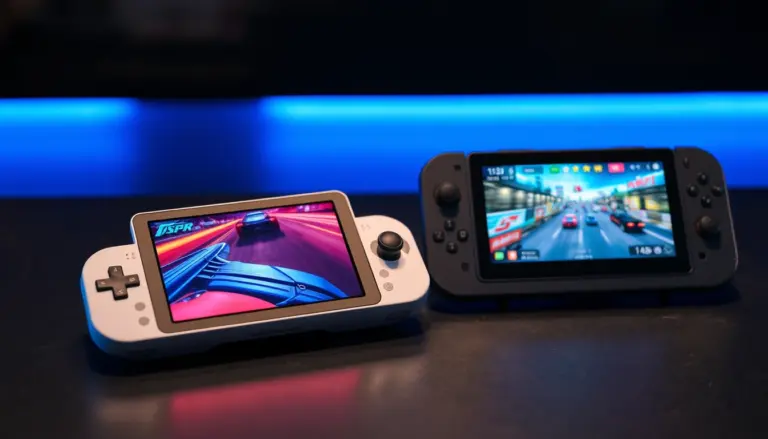
The handheld gaming market has changed dramatically in recent years. Instead of having to pick between an outdated portable console and a simple gaming PC, gamers have the option of high-powered gaming PCs that can be used anywhere to play demanding games.
Two that are well-known are Nintendo’s Switch 2 and Valve’s Steam Deck. Both allow you to play games without a television, but in very different ways of handheld gaming.
Comparing the Nintendo Switch 2 vs Steam Deck isn’t just about the processors. Nintendo’s games are all exclusive and the hybrid console experience is it’s bread and butter, while Valve’s games are in the vast Steam library and the PC is portable.
Let’s take a look at their similarities.
Design and Portability
The Nintendo Switch 2 has been built as a hybrid console. It may be used as a hand-held device, stand on a table (included stand), or attach it to a TV via the included dock.
The console has a 7.9-inch LCD display with a 1920 x 1080 resolution and support for HDR. The company also made the controllers of the Joy-Con 2 bigger than the original Switch, allowing for extended play times.
The Steam Deck, on the other hand, is at a much more advanced stage of traditional portable gaming PC development. The standard version has a 7-inch LCD display, and Valve is also developing the Steam Deck OLED with a bigger 7.4-inch OLED screen.
The Steam Deck is not only bigger but also heavier than the Switch 2. If you intend to take your handheld device with you everywhere, this is important.
The Nintendo design is more flexible for those who wish to game either on the TV or handheld. The Steam Deck’s main focus is on mobile PC gaming.
Performance
It is at this point that the comparison becomes interesting.
The Switch 2’s processor is also a custom-built NVIDIA chip that is optimized for the console. According to Nintendo, it is compatible with technologies like DLSS, which can enhance and boost images and performance with AI-based image reconstruction.
The console is also more powerful than the original Nintendo Switch, and can run those games at higher resolution when viewing them on a TV.
The Steam Deck features an AMD APU with 4 CPU cores and 8 GPU compute units (RDNA 2). It has 16GB of LPDDR5 RAM.
The Steam Deck is a few years old, but with a PC-style architecture, there is a lot of flexibility available for players. Depending on the game the user can adjust graphical settings, frame rates, resolution and other performance options.
The Switch 2 is a more contained console experience. While developers optimize the games for the hardware, Steam Deck users have a much greater degree of control over how the games run.
Game Library
One of the biggest differentiators between the two handhelds Nintendo Switch 2 vs Steam Deck are the games.
The biggest advantage is Nintendo’s exclusive software. Switch 2 will feature Nintendo titles like Mario, The Legend of Zelda, Pokémon, Animal Crossing, Super Smash Bros. and Mario Kart.
Switch 2 versions and updates have also been released for some games, leveraging on the newer hardware.
The Steam platform will also be available to the Steam Deck, allowing players to enjoy access to a vast library of PC games. This includes thousands of games from top publishers and independent developers.
However, Steam compatibility isn’t universal. Certain anti-cheat systems and game launchers might mean some PC games don’t play exactly as they should on Steam Deck. Valve has a Steam Deck compatibility system to show you which games have been tested and categorized for the Steam Deck.
If you’re looking for Nintendo’s first-party games, however, you will have an advantage when it comes to Nintendo. Steam Deck is more versatile when it comes to PC gaming.
Display
The Switch 2’s LCD screen supports HDR10 and has a resolution of 1920 x 1080, with a 7.9-inch diagonal. It also supports up to 120Hz refresh rate in compatible games.
The larger sized screen allows for games to be more visible on the handheld, and the HDR support can improve the contrast and colors of compatible games.
The Steam Deck OLED’s 7.4″ HDR OLED display resolution is 1280 x 800 at 90Hz. The Steam Deck’s OLED features deeper black levels and higher contrast, thanks to OLED.OLED effects the Steam Deck’s OLED display with deeper black levels and better contrast.
It is up to you to decide which you prefer. The advantages of an OLED display are found in Steam Deck OLED, and Switch 2 has a higher resolution.
Battery Life
Battery life depends heavily on the game being played.
Nintendo estimates the battery life of the Switch 2 to be around 2-6.5 hours of gameplay. Battery life can be more quickly depleted in more challenging games.
The original Steam Deck LCD will last about 2-8 hours, and the Steam Deck OLED will last about 3 to 12 hours, depending on the game and settings.
When playing intensive games, neither device can be regarded as gaming equipment for all day use.
The Steam Deck provides users more control over performance settings, making them able to lower their frame rates or graphical settings to lower the amount of power the device uses. Nintendo offers a more uniform experience since the developers is responsible for optimizing the games.
Storage
Storage is of other significant concern.
The Nintendo Switch 2 has a bigger 256GB internal storage compared to the original Switch. Though today’s games take up a lot of space, however, more storage might be needed some day.
The Switch 2 comes with expandable storage in the form of microSD Express cards.
The amount of storage on Steam Deck varies by configuration. Valve has had several different sizes of SSD in the past and the Steam Deck is also microSD card capable.
The big change is that Steam Deck offers technically advanced users greater flexibility when it comes to storage management and potential upgrades, depending on the Steam Deck model and situation.
Controls and Features
Nintendo has some unusual features that separate the Switch 2 from conventional handheld PCs.
The Joy-Cons come with attachments, so the console can be used in various setups. It also utilizes motion controls and Nintendo’s accessories and item ecosystem.
Steam Deck is equipped with two trackpads as well as the traditional controller. These can be particularly helpful for PC games which were originally built around a mouse and keyboard.
There are also four grip buttons on the rear of the Steam Deck, offering more control in compatible games.
Nintendo’s control system is easy to use for traditional console games. Steam Deck has extra functionality for its PC games that can be very handy.
Price
The Nintendo Switch 2 is priced at $449.99 in the United States, but different regions have different prices.
The Steam Deck is available in various storage options, with the lcd and oled versions of the device having different retail prices. The OLED are newer models that are at a higher price point than the LCDs.
The exchange rate, shipping and import charges and retail markups can make the imported handheld consoles significantly more expensive than the official U.S. price for the buyers in Nigeria.
Therefore, it is advisable to compare the cost of devices in the region carefully before purchasing any of them.
Nintendo Switch 2 vs Steam Deck: Which One to Choose?
The Nintendo Switch 2 vs Steam Deck decision ultimately comes down to what kind of gamer you are.
For those looking for Nintendo’s exclusive title, the Switch 2 is the simpler option that is a hybrid console that connects to a television and offers a more streamlined plug-and-play experience.
The Steam Deck is more for the individual who desires a portable gaming PC. It’s also tied to Steam, offering access to a massive library for PC games, and the operating system and hardware give more control to the more advanced player.
This also makes the Steam Deck more alluring to PC gamers with a vast Steam library.
Final Thoughts
The Switch 2 and Steam Deck are both handheld gaming devices, and they have utterly different philosophies.
Nintendo have some emphasis on its own games, the simplicity of the console and the ability to switch from handheld to TV mode. Valve is all about gaming on the PC in a flexible way and allowing players to be able to access their current Steam library.
If you’re looking for a handheld for Nintendo’s exclusive games, the Switch 2 is clearly the choice. The Steam Deck is a very different experience if you already have a huge Steam library or prefer playing with a portable PC.
For the majority of buyers, the games they wish to play ought to be the starting point for the choice. If it’s established that these are same, then differences in hardware, display, controls, portability and software become much easier to deal with.