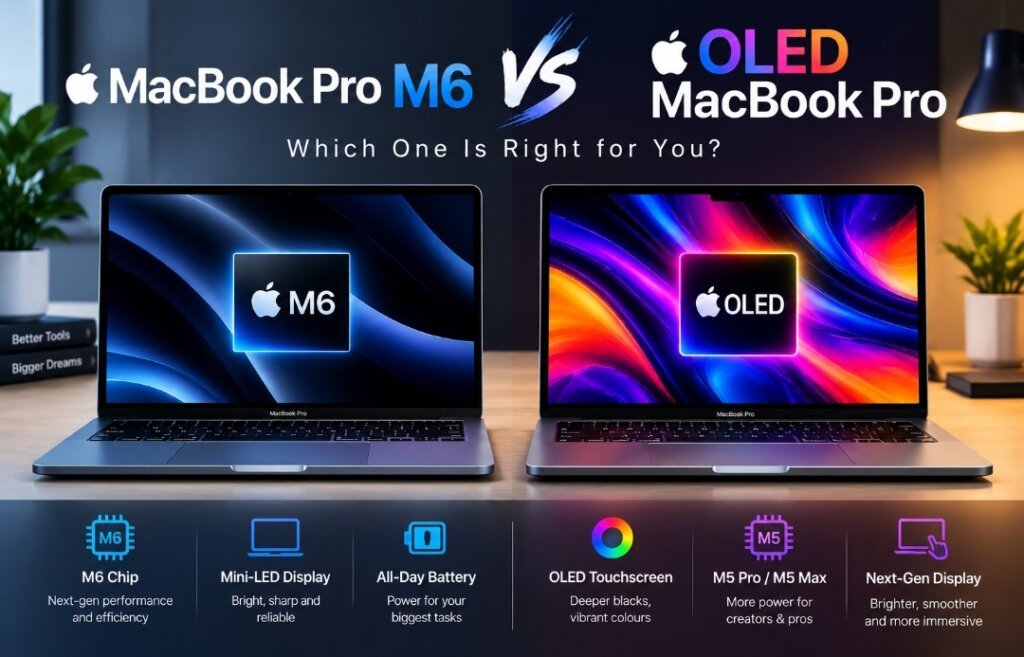
Apple has introduced two interesting MacBook Pro options for people looking for a powerful laptop in 2026. One focuses on the new M6 chip, while the other brings an OLED touchscreen display, a redesigned body, and Apple’s M5 Pro or M5 Max processors.
Both laptops target professionals, students, developers, and content creators, but they offer different advantages. If you are planning to buy a new MacBook, understanding these differences can help you avoid spending extra money on features you may not need.
In this MacBook Pro M6 Vs Oled MacBook Pro comparison, we look at performance, display quality, design, battery life, pricing, and the type of user each laptop suits best.
Design and Display
The MacBook Pro series maintains Apple’s traditional design, with the standard 14-inch model sporting the M6. It’s equipped with a Liquid Retina XDR display with mini-LED technology for bright highlights, rich colours and deep blacks. It is also available in an optional nano-texture finish to minimise reflections in bright settings.
The OLED MacBook Pro is the one that’s got a more prominent change. Apple has announced 14-inch and 16-inch models featuring a tandem OLED display with touchscreen support. The display has up to 120Hz refresh rate and 2,000 nits peak brightness for HDR scenes. The new models are also slimmer and smaller in weight than the previous ones.
OLED technology can generate independently controlled pixels, meaning portions of the screen can look as black as possible. This can enhance contrast as well as make films, photos, and other visual information more impressive.
For those desiring a new display experience, the OLED option is the more interesting one to consider. But the normal M6 version still has a good quality display that’s great for work.
Performance and Processor
The other key difference between MacBook Pro M6 Vs Oled MacBook Pro is performance.
Apple’s M6 chip is standard on the MacBook Pro, which has 12-core CPU and 12-core GPU. According to Apple, the graphics performance of the GPU is up to 30% faster than the previous M5 chip, and AI workloads run on device can be up to 25% faster. These are Apple’s numbers, actual numbers will vary based on the application and workload.
The OLED MacBook Pro, on the other hand, features the M5 Pro or M5 Max chip. These processors are capable of handling heavy workloads such as video editing, 3D graphics, software development and more, which can benefit from powerful processor and graphics capabilities.
This means the M6 model is not automatically the more powerful laptop in every situation simply because it has a newer chip generation. Apple’s higher performance chip tiers are the M5 Pro and M5 Max.
The M6 should give you more than enough power for all your everyday productivity, programming, schoolwork and general creative activities. The larger video projects, complex 3D scenes or demanding workloads might be better suited to an OLED model with an appropriate Pro or Max configuration.
Touchscreen Features
The new OLED MacBook Pro brings touchscreen functionality to the MacBook Pro lineup. It allows the user to interact directly with the display, while retaining the traditional keyboard and track pad. The new design also includes a Dynamic Island-like interface in Apple’s design.
This might come in handy for creators who want to engage more with their creation, use some applications, or make some changes without using the trackpad alone.
The standard M6 MacBook Pro doesn’t have the same touchscreen experience. It still uses the keyboard, trackpad and other conventional input methods.
While many people may not need touchscreen support, users who typically write, code or use a spreadsheet might not find it to be as important. The OLED version, however, might be more desirable for users who have been wanting a touchscreen MacBook for quite some time.
Battery Life
Battery life is a factor to consider when selecting a laptop for work, school or travel.
According to Apple, the M6 14-inch MacBook Pro can last up to 24 hours on a single charge, based on its claims.Understated according to Apple, MacBook Pro 14-inch M6 can get up to 24 hours of battery life. The company also notes enhanced performance per watt, which means the laptop can run at an efficient level when it comes to heavy workloads. The actual battery life will differ based on brightness, applications, network activity and workload.
The OLED versions are also designed for portability and work as a professional display, but battery life will vary based on the specific configuration and use of the display and processor. Power consumption may be influenced by touchscreen activity, HDR content, intensive creative work, etc.
If battery life is the most important factor, check independent battery tests of the models you’re looking at, before you buy. There is no straight correlation between the size of the display and battery life.
Price and Value for Money
Price is one of the clearest differences between these laptops.
The US price of the 14-inch M6 MacBook Pro begins at $1,999. The OLED MacBook Pro is $2,899 for the 14-inch and $3,399 for the 16-inch. The higher the performance of the processors and other configuration improvements, the higher the price.
That’s a big gap. These newer features — the OLED screen, touchscreen, reconfigured body and higher-end processor options — are all worth the price increase to the buyer?
Availability and retail margins as well as exchange rates may affect prices in Nigeria. Before checking the local cost be sure to find out the exact memory and storage configuration.
Final Verdict
The MacBook Pro M6 Vs Oled MacBook Pro decision comes down to your priorities and budget.
Overall, the M6 is a great option for a balance of price, performance, and battery life. The OLED version features a more high tech display, touchscreen and more sophisticated processors for heavy duty professional work.
But neither are the best options for all. If you want a powerful MacBook Pro at a lower starting price, choose the M6 model. The OLED version might be more expensive if you are looking for the new touchscreen OLED experience and require the extra functionality of an M5 Pro or M5 Max setup.