I’ve tried several times to picture this scenario but every time I tried, it leaves me with goosebumps. Imagine waking up tomorrow — and all phones have disappeared into thin air. No more iPhone, android, no calls, messages, photos, or apps in the palm of your hand. At first, you’d probably (like I did) panic just a little. Phones are attached into nearly every part of our modern life. They’re our cameras, navigation tools, wallets, social hubs, and so much more.
But what if phones disappeared tomorrow? What tech would step in to replace them and would our lives really fall apart?
In this article, I discuss and walk you through the most realistic technologies that could replace phones, how they might work in real life, and what challenges and opportunities each one brings. By the end, you’ll have a clear understanding of what tech would replace phones, why those options matter, and how life could shift in a world without pocket-sized devices.
Why Explore a Phone-Free Future?
It is worth considering why phones are so important to us before we consider alternatives.
Phones do so many things:
- Communication: voice, text, messaging applications.
- Connection: email and social media.
- Navigation: GPS and maps
- Media: streaming, videos, photos, music.
- Payments: mobile wallets
- Productivity: notes, documents, calendars.
They are not just any devices but centers of everyday life. And so in case your phones were gone, you would need something to replace them that would all cover those functions. Today, there is no single device that can do everything that a phone can do, however, a combination of new technologies may.
This is what such a future might look like.
1.Wearables: The Closest Replacement.
The first thing that crosses your mind when deciding to open the list of options is, likely, wearables, particularly smartwatches and smart glasses.
Smartwatches
Phones have already been replaced by devices such as the Apple Watch, Galaxy Watch, and others:
- Connected to a network, calls and messages.
- Notifications
- Health tracking
- Payment and navigational apps.
Smartwatches already have so much power. Modern models include:
- Touch screens, high-resolution.
- Connection between the cells (not phone-dependent).
- High-performance app and task processors.
Wearables can replace phones in a short time, if phones disappear tomorrow. You would talk, make payments, monitor health and even navigate with nothing but your wrist. However, there is a twist: small screens cannot substitute all the functions of phones. Wristwear remains inadequate when it comes to long text/video viewing and high productivity.
Smart Glasses
This is where the future almost becomes sci-fi.
Imagine having glasses that display your apps, messages, and notifications in your sight. Businesses are already trying to come up with models that can:
- Show digital overlay on life scenes.
- Understand gestures or voice commands.
- Navigation directions and stream media.
Although smart glasses are still not widely used today, they are a sign of something new: a constant interface that does not involve carrying a device.
A smartwatch and a smart pair of glasses create a wearable ecosystem that begins to answer the question of what tech would replace phones, yet we still need several more components.
2. Voice Assistants and AI Interfaces.
Even without phones, you would miss talking to technology and that is where voice assistants such as Alexa, Google Assistant, and others would come in.
However, the new generation of voice AI would be much more integrated:
- Context-aware conversations
- Proactive task suggestions
- Strong integration with apps and services.
- Voice-only communication
There are not so many tasks that you would need screens. It only takes voice to ask directions, summarize messages, play a playlist or even make reservations.
Combined with wearables, modern voice AI would be the interface to all your virtual requirements.
3. Smart Clothing and Haptic Feedback Devices.
This may seem futuristic, but technology is already on this road.
Imagine clothing with sensors that:
- Detect gestures for control
- Give feedback using minute vibrations.
- Link to networks freely.
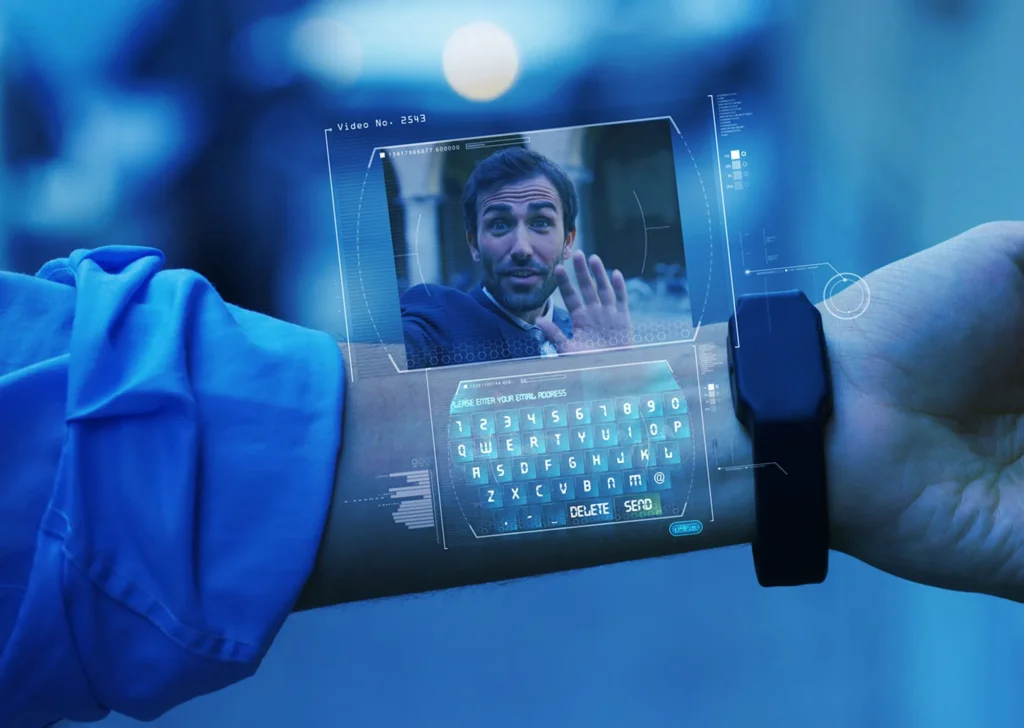
You could tap your sleeve to pick up a call, swipe your wrist to scroll a message, or even feel the alerts.
This is not mainstream yet, but smart clothing and haptic might have a solution to some of what tech would replace phones – particularly with simple daily tasks that do not need in-depth images.
4. Augmented Reality (AR) Contact Lenses.
We are really going into the future now.
Major technological organizations are researching AR contact lenses, which are essentially digital interfaces embedded directly into what you put on your eyes.
Here’s what they could do:
- Add digital data to your physical world.
- Replace screens entirely
- Deliver context-relevant visuals, messages, and tasks.
Think of going down the street and seeing directions on the street, reading a message without a screen, or even surfing the web in the air.
It is a radical solution to what technology would replace phones, and although the general adoption of the technology could be years off, it is a promising vision.
5. Modular Personal Devices Networks.
Without phones, one of the greatest frustrations would be connectivity. You require a means of remaining connected to networks via calls, messages, and data.
This would be resolved through a net of personal devices that would act as a distributed network:
- Wearables talk to one another.
- Home hubs handle heavy tasks
- Devices are connected with demand through the public infrastructure.
It will not be a single device (the phone), but an ecosystem of interconnected devices that share tasks.
For example:
- Smartwatch processes fast messages.
- Smart glasses control visual display.
- Categorical clothing understands gestures.
- Home hub offers storage, cloud access and heavy computing.
They collectively create a digital ecosystem that takes the place of the centralized position of the phone.
6. Brain-Computer Interfaces (BCI)?
Next, we can mention the most futuristic concept: interfaces that could be connected to your brain.
This appears to be a science fiction, though research is progressing rapidly. BCIs could one day let you:
- Consider a command and execute it.
- Send non-verbal messages without the need to speak or type.
- Neural input control devices.
Once that becomes viable and secure, it would redefine what tech would replace phones fully, turn phones into a relic, not just in fact but in thought.
BCIs are a real frontier of the future, but we are not there yet.
So What Would (Literally) Replace Phones?
Having examined all these technologies, it is not a single piece of technology that is the answer, but a system of technologies combined with each other:
- Wearables: Intelligent mobility device and simple controls.
- AR visual information devices.
- Voice AI which is conversational.
- Portable networked personal devices.
New technology such as BCIs to ensure smooth human-tech interaction.
Collectively, these platforms would intervene in the case of disappearance of phones tomorrow, not as a one-to-one replacement, but as a networked system that sustains all digital life.
The future will not be about holding a phone. It will consist of bringing your digital world with you without having to carry a box.
What This Means for You Today
You may be thinking: “Wow, this sounds cool, but how soon will it happen?”
Here’s the truth:
- Smart wearables and voice assistants are already with us
- Smart glasses and advanced AR are in early rollout phases
- Smart clothing and haptic tech are emerging
- BCI is still in research and testing
What this means for you right now is simple:
You don’t have to wait for the future — you can start living in it by adopting technologies that already share your digital load. Smartwatches and voice assistants can make your life more connected today, and starting with those changes can prepare you for even bigger shifts tomorrow.
Final Thoughts: A Future Without Phones — Is It Better?
If phones disappeared tomorrow, life wouldn’t stop — but it would change dramatically. You might even find that you enjoy more natural interactions, less screen obsession, and more fluid connectivity.
Answering what tech would replace phones isn’t just my thought experiment. I’m trying to stir your mind to think deeper in another direction. It’s a roadmap of where consumer technology is heading — toward more immersive, integrated, and human-centered interfaces.