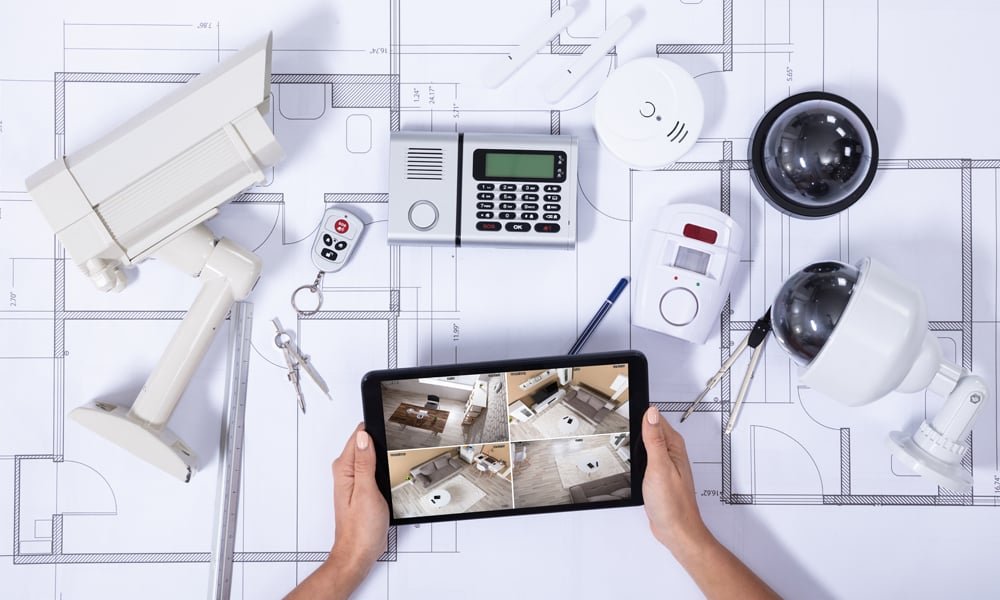
The future of home and business security is no longer about locks and alarm sirens in 2026. The actual argument of the day is Smart Security vs Traditional Security – and more to the point what breaks down first when you really need it?
This paper simplifies it into clear and achievable terms. No marketing hype. No vague claims. Only real-life comparison to help you make the right choice about your property.
What We Mean by Smart Security vs Traditional Security.
We might first define the two before comparing their failure points.
Traditional security systems entail:
- Wired alarm panels
- Motion detectors
- Basic CCTV systems
- Physical key locks
- Security guards
They are very dependent on physical hardware and also landline connections.
Smart security systems are composed of:
- Wi-Fi or cellular cameras.
- App-controlled locks
- Cloud-based monitoring
- AI motion detection
- Smart doorbells
- Real-time mobile alerts
The most significant distinction in the Smart Security vs Traditional Security argument is connectivity. Smart systems are based on internet and cloud services whereas traditional systems are based on physical wiring and local hardware.
So now we get to the big question, what fails first?
Failure Scenario #1: Power outage.
Power outages continue to occur in 2026 – particularly in areas where the power grids are also unstable.
Traditional Security:
The majority of the wired alarm systems are fitted with a backup battery that lasts between 8 and 24 hours. However, CCTVs can go off unless they are attached to a UPS or generator.
Smart Security:
Battery backups are also provided in smart cameras and hubs, but are normally not provided in Wi-Fi routers and modems. In case of internet failure, you can lose remote access in real time, although certain systems will keep recording on-site.
Verdict:
Traditional wired alarms can take longer to shut down in a mere power failure, but not in cases of an outage of the internet. However, the modern intelligent systems with cellular backup are bridging the gap.
Failure Scenario: #2 Internet Outage.
Here the Smart Security vs Traditional Security is more interesting.
In case of an internet failure:
- Live streaming can be prevented by smart cameras.
- Cloud-based alerts may pause.
- Remote access will be lost.
Nevertheless, most 2026 smart systems currently have:
- Internal memory (SD cards or NAS)
- The connectivity of cellular fallback.
- Offline recording features
The first place is that traditional systems are not based on the internet. They activate alarms in the area and can include cellular modules in the event of an emergency.
Verdict:
Smart systems become more exposed to internet failure without having a backup connectivity. Older systems are not cloud-dependent and hence they do not change.
Scenario of failure #3: Physical tampering.
Let’s talk about break-ins.
Wired systems that are traditionally used can be rendered out of service when a person cuts visible cables prior to sensor activation. The older CCTV cameras are usually positioned in an open place and are prone to damages.
Smart security systems use:
- Tamper alerts
- Cloud uploads via motion.
- Hidden wireless cameras
In comparison of Smart Security and Traditional Security, smart systems tend to alert immediately when one is trying to meddle. Others can even start recording prior to the movement being completely recorded courtesy of AI pre-buffering.
But there are vulnerabilities in case Wi-Fi is jammed or routers are unplugged.
Verdict:
There are weaknesses of both systems. Conventional systems can be easily cut by physical means. Smart systems are susceptible to interference of signals – without the use of encrypted networks and cellular backup.
Failure Scenario #4: Human error.
It is in this case that most security failures actually occur.
Traditional systems rely on:
- Manual arm/disarm
- Physical keys
- Remembering alarm codes
Smart systems rely on:
- App notifications
- Biometric unlock
- Auto-arm scheduling
- Anywhere remote control.
Practically, traditional systems tend to be forgotten by the homeowners. Intelligent systems are able to automatically arm when you are not at home (geofencing).
Verdict:
Traditional systems are more prone to failure because of human memory loss. Smart systems reduce this risk through automation.
Cybersecurity Risks in 2026
This is among the key points of discussion of the Smart Security vs Traditional Security.
Smart systems are interconnected devices and any interconnected device can be attacked by hackers unless it is well secured. Weak passwords, out of date firmware and insecure Wi-Fi networks present weaknesses.
Offline systems like traditional systems are not as vulnerable to cyber threats. Yet they do not have encryption and superior digital safeguards.
It does not matter whether a system is smart or not, but it matters whether it is configured correctly.
Best practices of smart systems:
- Two-factor authentication should be enabled.
- Use strong, unique passwords
- Keep firmware updated
- Use encrypted Wi-Fi (WPA3)
Smart systems are much more secure when properly configured than the older wired systems.
Reliability Over Time
The Traditional security systems are distinguished by extended lifespan. There are wired types of alarms that last up to 10 years with little maintenance.
Smart systems develop rapidly. Software ecosystems are dynamic, so devices could become obsolete in 5-7 years. Nevertheless, they can be enhanced by software upgrades, which is not possible with the traditional systems.
In 2026, this matters. The motion detection powered by AI is more accurate with time, and the false alarms are considerably lower than those of older PIR sensors.
Cost and Maintenance
The conventional systems tend to demand contracts of professional installation and monitoring. The repair can include visits by technicians.
Smart systems are typically self-assembled and cloud services on subscription.
In a period of more than 5 years, the total costs may change based on:
- Monitoring fees
- Hardware upgrades
- Maintenance
No definite winner in terms of financial positioning – it depends on the complexity of the set up.
So, Which One Fails First?
Having compared Smart Security vs Traditional Security, here is the real truth:
Smart security will not work in the event of internet outages when there is no backup connection.
The traditional security collapses in cases of human error and physical interference.
Nevertheless, in the year 2026 hybrid systems are emerging as the most dependable.
The best strategy is to make a combination of:
- Wired alarm sensors
- Cellular backup smart cameras.
- On-premise storage and cloud backup.
- Effective cybersecurity measures.
This multi-tiered approach reduces the number of single points of failure.
Final Verdict (2026 Recommendation)
Smart security is more adaptable and provides real-time awareness, especially when you appreciate automation, remote access, and AI enhanced monitoring.
Traditional systems are reliable in case you care about simplicity and stability on-line.
The actual loser in the Smart Security vs Traditional Security debate in the modern time is neither over the other but integration.
Security 2026 is not a matter of taking sides. It is about getting rid of weak links. And the system that malfunctions first is one that has not been well maintained or configured.